
A surety bond means a licensed bail agent guarantees your release for a nonrefundable premium, usually a percentage of the total bail. A cash bond means you hand the court the full bail amount yourself, and you get it back later if the case wraps up the way it should. Pick cash if you have the money sitting free and want it back. Pick surety when you need someone out now and don't have the full amount on hand.
TL;DR:
- Surety bonds typically cost around 10% of the bail amount as a nonrefundable premium, which is faster to process but not refundable after payment.
- Cash bonds require paying the full bail amount upfront, which is returned after the case concludes if the defendant appears in court.
- If the defendant misses court, a cash deposit is kept by the court, while a surety bond triggers the bonding company to pay the court and then seek reimbursement, often through collateral.
- State laws vary widely, with some jurisdictions banning commercial surety, capping premiums, or delaying releases due to felonious fund holds under Penal Code 1275.
- The choice depends on your liquidity, willingness to put collateral at risk, and the speed with which a bond can be posted in your county.
Table of Contents
- Surety Vs Cash Bail: What a Surety Bond Actually Involves
- Surety Vs Cash Bail: How Posting Cash Actually Works
- Cost, Refund, and Speed Compared Side by Side
- Deciding Between Cash and Surety: A Step-By-Step Approach
- What Happens When a Bond Is Forfeited or Court Is Missed
- State Rules Vary More Than People Expect
- Author Perspective: What Actually Matters When You're Making This Call
- How Abaasy Bail Bonds Helps When You Need to Move Fast
- Sources
- FAQ
Surety Vs Cash Bail: What a Surety Bond Actually Involves
A surety bond brings in a third party. The defendant is the principal, the court is the obligee, and a licensed bail agent or bonding company acts as the surety, promising the court the full bail amount if the defendant skips town. That guarantee costs money upfront, and it never comes back.
Premiums commonly land around 10% of the total bail, though rates vary by state and some jurisdictions cap or restrict what a commercial surety can charge. A handful of states ban commercial surety altogether. Before signing anything, expect the agent to ask for:
- An indemnity agreement, which makes you personally responsible if the surety has to pay the court
- Collateral, such as a car title, home equity, or jewelry, on larger or riskier bonds
- A cosigner if your credit or assets don't cover the exposure
If the defendant fails to appear, the surety pays the court, then comes after the indemnitor to recoup that money, often by seizing collateral or filing a civil suit.
Pro Tip: Read the indemnity clause before you sign anything. It usually gives the bonding company broad authority to seize collateral the moment they pay out, not after a lengthy dispute.
Surety Vs Cash Bail: How Posting Cash Actually Works
A cash bond skips the middleman. It's a two party deal: you and the court, nothing else. You pay the full bail amount directly, in cash, cashier's check, or sometimes by card depending on the county, and the funds sit with the court until the case resolves.
If the defendant shows up to every hearing and the case closes out, that money comes back, minus whatever administrative fees or outstanding fines the court deducts. Refund timelines and deduction rules differ by county, so ask the clerk directly rather than assuming.
To post a cash bond, you'll typically need to:
- Confirm the exact bail amount with the jail or court clerk
- Bring acceptable payment (many jails won't take personal checks)
- Get a receipt that lists the amount, date, case number, and clerk contact for later reference
Cash makes the most sense on lower bail amounts, or when you'd rather eat the wait for a refund than hand a bondsman a fee you'll never see again.
Cost, Refund, and Speed Compared Side by Side
The two options split cleanly on four points that matter to most families.
- Money required upfront: cash demands the full bail amount; surety needs only the premium, often a fraction of that.
- Refundability: cash comes back after the case closes; the surety premium is gone the moment you pay it, no matter what happens later.
- Who eats the loss on a no-show: with cash, the court simply keeps the deposit; with surety, the bonding company pays the court first, then chases the indemnitor for reimbursement.
- Speed to release: surety agents can usually move faster since they're not waiting on you to gather the full amount, which matters when someone is sitting in a cell overnight.
Families with savings sitting idle often save money going with cash. Families without that cushion lean on surety because it turns a large, immovable number into a smaller, payable one.
Deciding Between Cash and Surety: A Step-By-Step Approach
Start with a hard look at your own finances before you call anyone. Can you free up the full bail amount without derailing rent, payroll, or a car payment? If yes, cash may be the cheaper route long term. If the number is out of reach, surety turns that same amount into a manageable percentage.
Work through this checklist:
- Liquidity: how much can you access today, not next payday
- Timeline: does the jail process cash faster than a bondsman can post surety in your county
- Collateral: are you willing to put a car title or home equity on the line
- State rules: does your state allow commercial surety, and does it cap the premium
Once you know your constraints, contact the court clerk to confirm the exact bail figure and accepted payment methods. Then call a licensed bail agent for a written quote. Ask directly: What's your license number? What percentage do you charge? What are the payment plan terms? What's your collateral policy? What happens if the defendant misses a court date, and how fast will you act to locate them?
Pro Tip: Walk away from any agent who won't put fee terms in writing, demands collateral that far exceeds the bond amount, or hints they can speed things up through channels that sound less than legal.
What Happens When a Bond Is Forfeited or Court Is Missed
Missing a court date triggers very different consequences depending on which route you chose.
With a cash bond, the court can simply keep the deposit. You can typically file a motion to set aside or vacate the forfeiture, but that requires showing good cause and often a hearing, and there's no guarantee the judge grants it.
With a surety bond, the bonding company pays the court the full bail amount, then turns around and pursues the indemnitor. That can mean:
- Seizing any collateral pledged in the indemnity agreement
- Filing a civil suit to recover the paid amount
- Hiring recovery agents to locate and return the defendant, which can escalate tension and legal exposure for everyone involved
On top of the financial fallout, a missed court date can bring a separate failure to appear charge, stacking new legal trouble onto the original case. If a hearing gets scheduled, showing up and communicating with the court or the surety early tends to go a lot further than ignoring the notice.
State Rules Vary More Than People Expect
Bail law isn't uniform. Some states cap surety premiums, some ban commercial surety outright, and cash deposit rules, refund timelines, and administrative fees all shift from state to state.
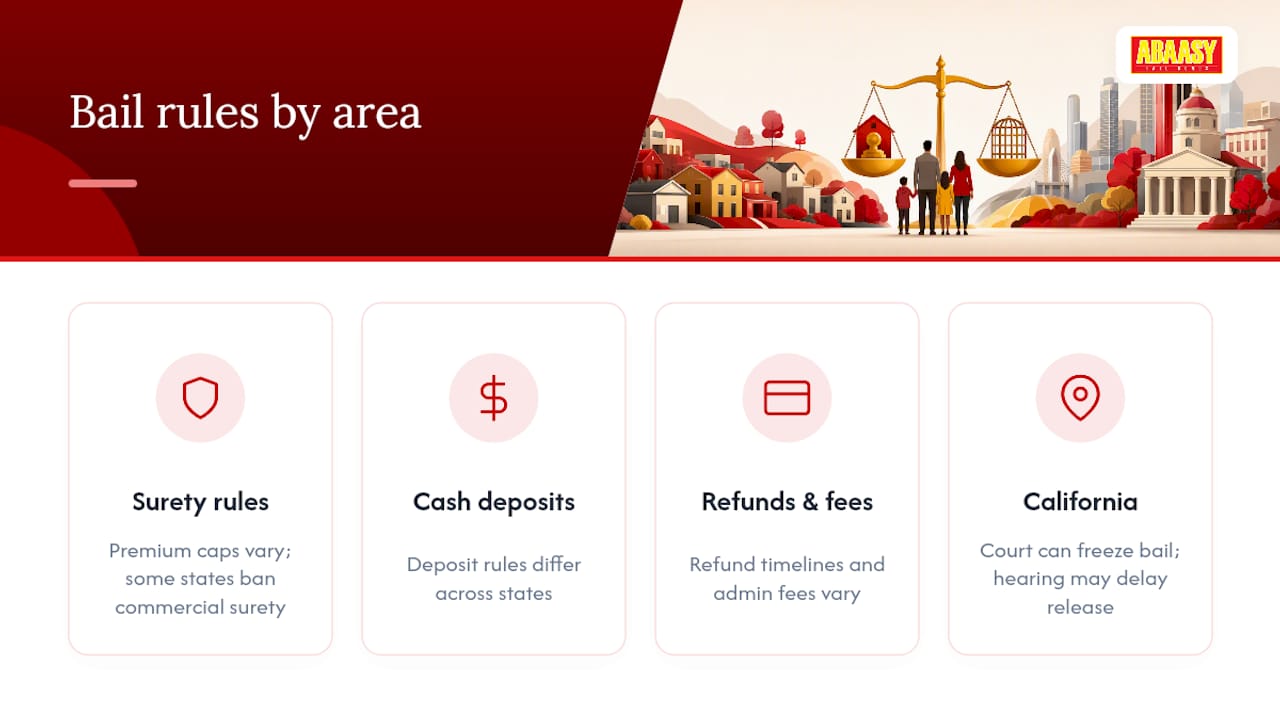
California adds another wrinkle worth knowing before you post anything. Under Penal Code 1275, a court can freeze acceptance of bail if there's probable cause the funds came from felonious activity. The defendant then has to prove, at a hearing, that the money is legitimate, which can delay release by days. Always confirm current refund rules and any hold procedures with your local court clerk before assuming your county works like the last one you dealt with.
Author Perspective: What Actually Matters When You're Making This Call
Cash saves money if you have it lying around and don't mind waiting for it back. Surety costs more in the long run but keeps your savings intact and usually gets someone released faster, which counts for a lot when a job or a child's school pickup is on the line.
What separates a smooth release from a stressful one usually isn't the bond type. It's whether the agent answers the phone at 2 a.m., quotes a straight fee, and puts payment terms in writing before you sign anything.
— william
How Abaasy Bail Bonds Helps When You Need to Move Fast
Abaasy Bail Bonds is built for the moment cash isn't sitting in your account and someone you love is waiting in a cell. Instead of scraping together the full bail amount, you work with a licensed agent who handles the surety bond directly with the court, often getting a release moving within the hour.

Some bail bond companies run 24/7 emergency bail with real agents picking up the phone, not a call center, and offer bilingual (Spanish) service to facilitate communication. No-interest payment plans can be available so the premium doesn't have to hit all at once, and pricing may be quoted upfront without hidden fees. When you call, have the defendant's full name, the jail location, and the booking number ready if you have it. If you're unsure whether a 1275 hold applies to your case, Abaasy's agents can walk you through what that hearing requires. Start at the main Abaasy Bail Bonds page to reach an agent now.
Sources
Verify local rules before you commit to either route. These sources cover the legal groundwork this article draws on:
- California Penal Code 1275 (bail hold) — Hedding Law Firm
- Pretrial release conditions — National Conference of State Legislatures (NCSL)
- Cash bond vs surety bond — LegalClarity
- Congress
Your county clerk's office remains the most reliable source for exact refund timelines and accepted payment forms.
This article is general information, not a substitute for advice from a qualified lawyer. Consult a qualified legal professional about your own circumstances before acting on anything here.
FAQ
What Does a $50,000 Cash Surety Bond Mean?
It means the court will only accept bail in the form of cash or a cash equivalent, not a surety bond, and the full amount required has to be deposited before release. This condition often gets attached to cases where a judge worries a bondsman's guarantee isn't enough assurance the defendant will return.
What Are the Disadvantages of a Surety Bond?
The premium, typically around 10%, is gone permanently even if the case gets dismissed the next day. You're also on the hook through an indemnity agreement, meaning collateral or a cosigner's assets can be seized if the defendant misses court.
What Does a $100,000 Cash Surety Bond Mean?
Same rule as the lower amount version, just at a higher amount: the court requires the full cash bail rather than allowing a bail agent to post a percentage-based surety bond. It's usually ordered when a judge has specific concerns about flight risk or the source of bail funds.
What Are the Disadvantages of Cash Bail?
The biggest drawback is tying up a large sum of money, sometimes for months or longer, while the case works through the courts. If the defendant misses a court date, the court can keep the entire deposit, and getting that forfeiture reversed requires a formal motion and a hearing, with no guarantee of success.
Is a Surety Bond or Cash Bail Better for a Fast Release?
Surety bonds generally move faster because a licensed agent like Abaasy Bail Bonds can post the bond as soon as paperwork and payment terms are settled, without you needing to gather the full bail amount first. Cash bail can be just as fast if you already have the full sum on hand, but most families don't.