
Own recognizance (OR) means a judge lets you walk out of jail on your signed promise to show up in court, no money involved. Bail means the court sets a dollar amount, and you either pay it in full or pay a bail agent's premium to secure your release. The judge decides which one you get based on flight risk and public safety, not on what you'd prefer, and that decision shapes everything else: cost, supervision, and how fast you get home.
TL;DR:
- Own recognizance can be granted quickly for low-risk defendants with strong community ties, often within hours of arrest, without requiring any payment.
- Judges assess flight risk, safety concerns, criminal history, and financial situation before deciding between OR and bail, with recent reforms emphasizing ability to pay.
- Violating release conditions, whether for OR or bail, results in immediate re-arrest and potential forfeiture of bail or revocation of trust, with stricter consequences for missed check-ins or new charges.
- Pilot programs using risk assessments have increased non-monetary releases and reduced jail times, but county practices still vary widely based on local policies and resources.
- Most families need transparent, county-specific information about costs, timelines, and conditions; professional bail services offer 24/7 rapid assistance to expedite release.
Table of Contents
- Own Recognizance vs. Bail: The Core Legal Differences
- Who Qualifies: Eligibility Factors Courts Actually Weigh
- Conditions and What Happens When You Break Them
- How Release Actually Happens, Step by Step
- OR or Bail: A Quick Decision Guide
- Why These Two Systems Exist in the First Place
- What the Numbers Show About OR and Bail Outcomes
- Not Every County Handles This the Same Way
- The Ripple Effect on Jails and Court Backlogs
- Who Actually Makes the Call on OR vs. Bail
- Bail Reform Is Still an Open Fight
- What Families Actually Ask When They Call
- How Abaasy Bail Bonds Gets You Home Faster
- Primary Sources for This Article
- Sources
- FAQ
Own Recognizance vs. Bail: The Core Legal Differences
An OR release is a court-authorized release built entirely on a signed promise. Under California Penal Code §1318, the defendant agrees in writing to appear at every court date, follow any conditions the judge sets, not leave the state without permission, and waive extradition if they skip out. No cash changes hands.
Bail works the opposite way. The court sets an amount tied to the charge, and you either post the full sum with the court (refundable if you show up) or pay a licensed bail agent a nonrefundable premium, typically around 10% of the total in California, and the agent posts a bond for the rest.
Here's how the two break downside by side:
- Who decides: A judge or magistrate grants OR at arraignment; bail amounts often follow a county bail schedule but can be adjusted by a judge.
- Money involved: OR requires none; bail requires either full payment or a bond premium that you never get back.
- Speed: OR can happen at arraignment or even before, through cite and release; bail can happen almost immediately if you have cash or a bondsman on call.
- Supervision: OR can come with monitoring conditions; bail can come with conditions too, but enforcement usually runs through the bond rather than a pretrial officer.
Who Qualifies: Eligibility Factors Courts Actually Weigh
Judges do not flip a coin on release on own recognizance. They run through a short list of practical questions, and the answers determine whether you walk out on a promise or need cash.
- Flight risk: Do you have a job, a home address, and family in the area, or does it look like you might not come back?
- Public safety: Is the current charge violent, or does your record suggest a pattern that worries the court?
- Criminal history: Prior failures to appear weigh heavily against OR, while a clean record helps.
- Community ties: Steady employment and local roots make OR far more likely, which is part of why it's routine in traffic and low-level misdemeanor cases.
- Ability to pay: Since the California Supreme Court's In re Humphrey decision, judges must factor in a defendant's financial situation before setting bail, rather than defaulting to a fixed schedule.
Pretrial services often feed a risk-assessment report into this process before arraignment, giving the judge data instead of a guess. Pilot programs using these reports have increased non-monetary releases while decreasing rearrest rates in the courts that adopted them, which is a big part of why more counties are leaning on structured risk tools instead of rigid bail amounts.
Conditions and What Happens When You Break Them
OR is not a free pass. Courts frequently attach conditions, and supervised OR can look surprisingly close to a monitored bail release in practice.
Common OR conditions include:
- Regular check-ins with a pretrial officer, sometimes weekly or by phone.
- GPS monitoring or electronic check-ins for higher-risk cases.
- Mandatory referrals to treatment or counseling programs.
- Travel restrictions, including surrendering a passport in some cases.
Bail conditions can mirror several of these, plus a financial stake that disappears if you violate the agreement. Optional monitoring sometimes gets layered on for bail releases too, especially in domestic violence or DUI cases.
Break either one, and the consequences hit fast. A missed check-in or new arrest triggers a bench warrant almost immediately. For bail, the bond can be forfeited entirely, meaning the bail agent (or you, if you posted a personal indemnitor) may owe the full amount. For OR, the court simply revokes the release and you're back in custody, often without a new bail option offered. Either way, the next stop is jail until a judge reviews the situation, so understanding what happens if you miss a court date after posting bail matters before you sign anything.
How Release Actually Happens, Step by Step
Not every arrest leads to a jail cell. Officers can issue a cite and release for minor offenses, handing over a citation with a promised court date and skipping booking entirely. For more serious charges, you go to jail and wait for arraignment, typically within 48 hours excluding weekends and holidays.
At arraignment, here's what unfolds:
- Your attorney or the pretrial services team can request OR, sometimes backed by a risk-assessment report already on file.
- The judge reviews flight risk, safety concerns, and your ties to the community before ruling.
- If bail is set instead, you can pay the court directly or call a licensed bail agent, who typically needs your ID, the booking number, and payment or a payment plan before starting paperwork.
- Programs that use risk assessment before arraignment have cut wait times dramatically. One example from the Sonoma County pretrial program showed participants leaving custody in about 14 hours versus 71 hours for those going through traditional cash bail.
OR or Bail: A Quick Decision Guide
Neither option is automatically "better." It depends on your specific situation.
OR pros: No cost, no financial risk to family, and it avoids the debt that comes with a bond premium. OR cons: Conditions can be strict, and violating them offers little room for negotiation since there's no money on the line to lose.
Bail pros: Often faster if you have cash ready, and it can come with fewer day-to-day check-ins than supervised OR. Bail cons: The bond premium is gone for good even if every charge gets dismissed, and family members who cosign can be on the hook for the full amount if you skip a court date.
Pro Tip: Before assuming bail is your only option, ask the arraignment court directly whether pretrial services reviewed your case for OR eligibility. Many defendants never ask, and the request itself costs nothing.
Ask yourself three questions before deciding how to proceed: Can you realistically afford the bond premium without derailing your finances? Does your record suggest the court will view you as low risk? Is the charge serious enough that a judge is unlikely to grant OR regardless of your ties to the community?
Why These Two Systems Exist in the First Place
Bail as a concept goes back centuries, rooted in English common law, where the idea was simple: post something of value to guarantee you'd return for trial. The United States inherited that framework, and commercial bail bonding grew into an industry precisely because most people don't have thousands of dollars sitting around for a court date.
Own recognizance developed as a counterweight. Courts and reformers noticed that cash bail punished poverty more than it punished risk. Someone with strong community ties and a steady job might sit in jail for weeks simply because they couldn't afford bail, while a wealthier defendant facing a similar charge walked free the same day. OR release gave judges a tool to release low-risk defendants without that financial gatekeeping, based purely on the promise to appear and the defendant's ties to the community.
The rationale has only gotten more attention in recent years. Ability-to-pay considerations, formalized through cases like In re Humphrey, pushed courts to treat cash bail as one option among several, not the default. That shift reflects a broader argument: bail was designed to secure appearance in court, not to punish defendants before they've been convicted of anything.
What the Numbers Show About OR and Bail Outcomes
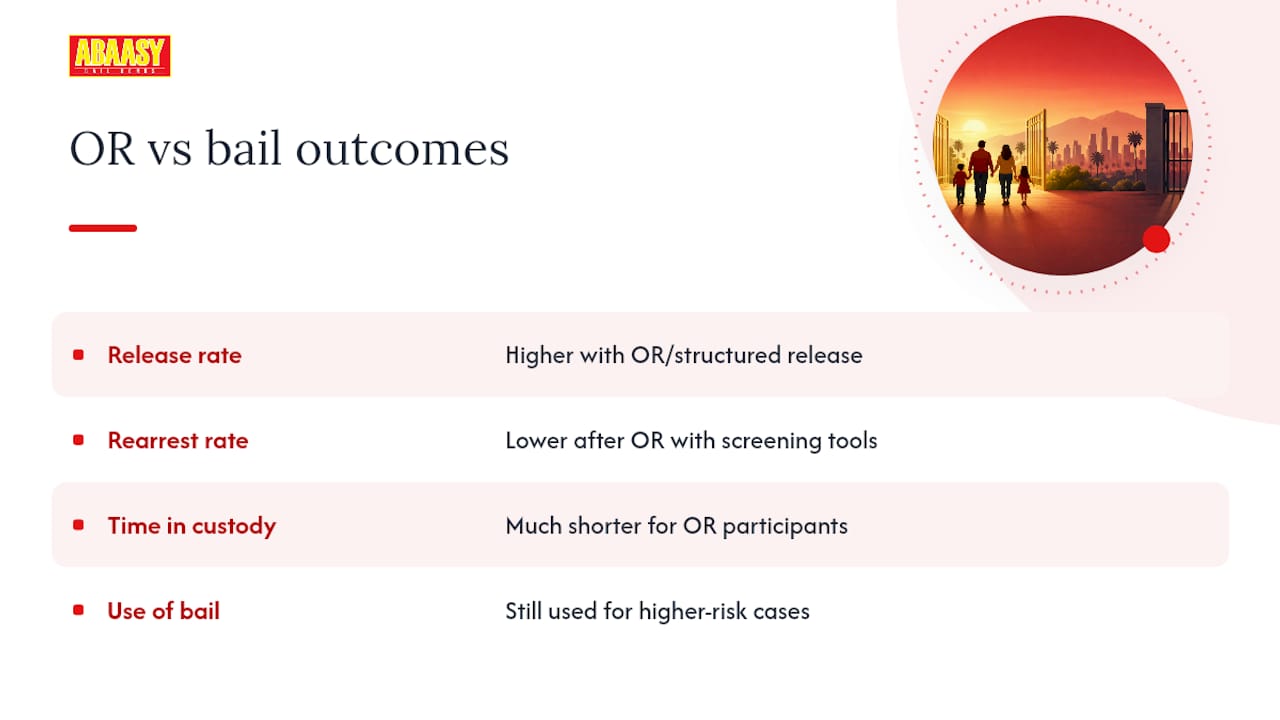
Pretrial pilot programs give the clearest picture of how OR and structured release compare to traditional cash bail in practice. Courts running these programs reported more defendants released before trial and a decrease in rearrest rates compared to jurisdictions relying on fixed bail schedules.
That finding runs counter to a common assumption that OR release is riskier than bail. Data from pilot courts suggests the opposite: when risk assessment tools screen defendants before release, both the release rate and the safety outcomes tend to improve. Defendants held mainly for inability to pay bail, rather than actual risk, added days or weeks of jail time that didn't correlate with better court appearance rates once alternatives were available.
Time in custody before release is where the numbers diverge sharply. As mentioned in the Sonoma County pilot, program participants spent far less time in jail before release compared to defendants processed through the standard bail system. That gap adds up fast across a jail system processing hundreds of bookings a day, and it's a major reason courts keep expanding these programs rather than treating them as a one-off experiment.
None of this means bail disappeared or should. Judges still rely on it for higher-risk cases, and commercial bail remains the most common path for defendants who don't qualify for OR. But the data on outcomes has shifted how courts weigh the two options at arraignment.
Not Every County Handles This the Same Way
California's counties don't apply OR and bail uniformly, even under the same state statutes. Some counties lean heavily on pretrial risk-assessment tools and grant OR more readily for eligible defendants; others still default to county bail schedules unless a defense attorney specifically requests a Humphrey hearing to argue ability to pay.
This matters practically. A defendant facing the same misdemeanor charge in one county might get OR with a check-in condition, while a defendant in a neighboring county sits with a set bail amount and no pretrial review unless their attorney pushes for one. Local court policy, judicial discretion, and how well-funded a county's pretrial services division is all factor into which path is more common.
Bail schedules themselves vary by county too, meaning the dollar amount attached to an identical charge can differ significantly depending on where the arrest happens. That's part of why the In re Humphrey ruling matters statewide: it gives defense attorneys a consistent legal argument for ability-to-pay review even in counties that haven't fully adopted risk-assessment based release.
If you're arrested outside your home county, or a family member is, it's worth asking a local attorney or a bail agent familiar with that specific courthouse how that jurisdiction typically handles OR requests, since assumptions based on one county's practice don't always transfer.
The Ripple Effect on Jails and Court Backlogs
Every OR release instead of a cash-bail hold frees up a jail bed and, just as important, moves a case forward faster. Counties running structured pretrial programs saw not just more releases and fewer rearrests, but faster overall case movement, since defendants who are out and stable tend to make court dates more reliably than those cycling in and out of custody stress.
Overcrowded jails have real downstream costs: longer wait times for arraignment, backed-up court calendars, and higher public spending on detention for people who haven't been convicted of anything. When more defendants qualify for OR or low-cost supervised release, that pressure eases somewhat, giving courts more capacity to actually process cases instead of just holding people.
The flip side matters too. When OR is used too narrowly and bail schedules stay high, low-risk defendants sit in custody purely because they lack funds, which can cost them jobs, housing, and custody arrangements before they've even had a trial. That instability sometimes makes future court appearances harder, not easier, creating a cycle that pretrial reform efforts are specifically trying to interrupt.
Neither OR nor bail is inherently the fix for jail overcrowding on its own. But the balance between how often each gets used has a direct, measurable effect on how fast a county's justice system actually moves.
Who Actually Makes the Call on OR vs. Bail
The judge has final say at arraignment, but three parties shape that decision before the gavel drops.
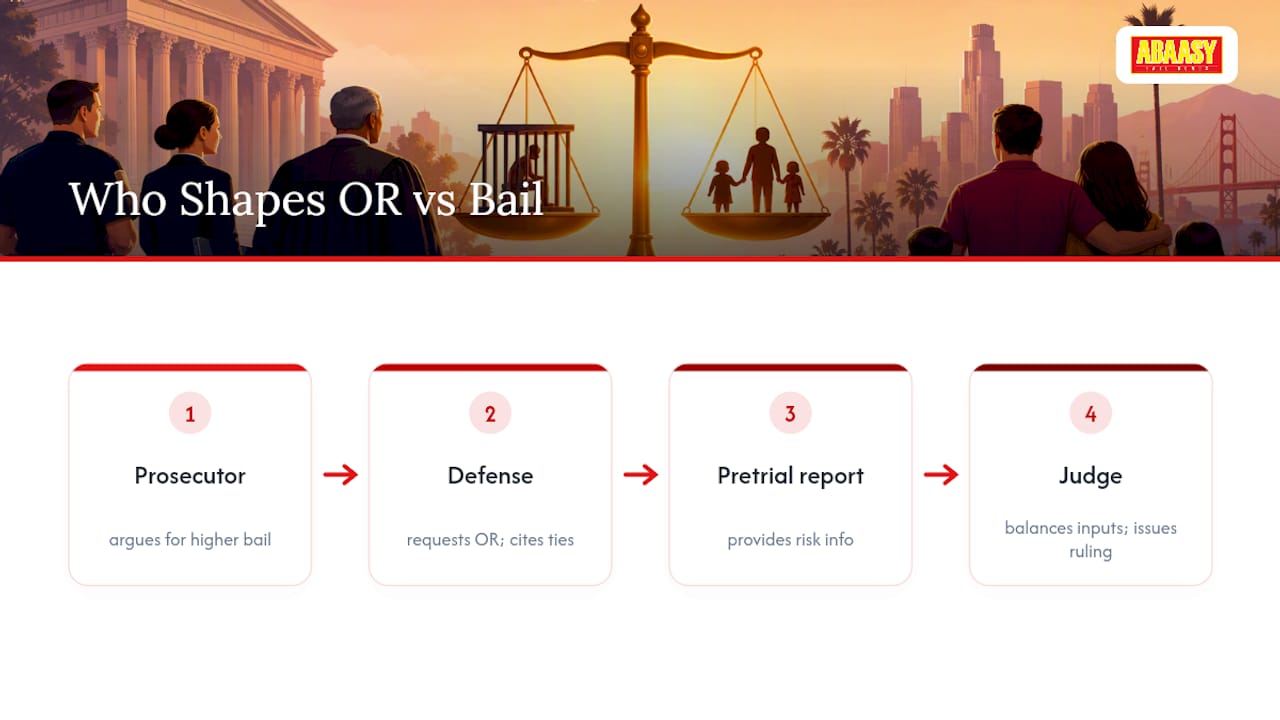
Prosecutors weigh in on the charge's severity and can argue for higher bail or against OR, particularly in cases involving violence or a defendant with a history of missed court dates. Their recommendation carries weight, but it isn't binding.
Defense attorneys are often the ones actively requesting OR, sometimes citing pretrial risk-assessment scores, community ties, or a Humphrey ability-to-pay argument if bail seems set beyond what the defendant can reasonably afford. A skilled defense attorney can push a case toward OR that might otherwise default to a standard bail amount, which is part of why speaking with counsel early, even a public defender at arraignment, matters more than most people realize. If you need help finding representation, a resource like a local criminal defense attorney can walk you through what to request at your specific hearing.
Judges balance all of it against the county's bail schedule, statutory guidance, and whatever pretrial report is on file, then issue the ruling. In practice, the judge's decision often comes down to how convincingly the defense presented risk factors versus how firmly the prosecution pushed back, which is exactly why the quality of that arraignment hearing matters so much for the outcome.
Bail Reform Is Still an Open Fight
California came close to eliminating cash bail statewide when voters rejected Proposition 25 in 2020, which would have replaced money bail with a risk-assessment system entirely. That vote didn't end the debate. It shifted it toward incremental changes instead, like expanding pretrial pilot programs county by county rather than mandating one system statewide.
The In re Humphrey decision remains one of the most consequential recent shifts, forcing courts to weigh a defendant's actual ability to pay before setting bail, rather than applying a flat county schedule regardless of income. Advocates for reform argue this doesn't go far enough since bail schedules still exist as a starting point in most courtrooms. Critics of broader bail elimination argue that removing cash bail entirely risks releasing higher-risk defendants without enough structure to ensure they return to court.
Pretrial risk-assessment tools sit at the center of this fight too. Supporters point to the reduced rearrest rates and faster releases seen in pilot counties as proof the approach works. Skeptics worry that algorithmic risk scores can carry their own biases if not carefully audited.
Expect this debate to keep evolving county by county rather than resolving in one sweeping law. For anyone facing an actual arraignment right now, the practical reality is that OR eligibility and bail amounts still depend heavily on which courthouse you're standing in.
What Families Actually Ask When They Call
Most calls come in during the worst hour of someone's week: a spouse, parent, or sibling just got the jail's phone call and needs answers immediately. In practice, the questions are almost always the same. How fast can this move? What does it actually cost? Will supervised release conditions make things harder than they already are?
The honest answer is that timelines depend on the county, the charge, and whether pretrial services already flagged the case for OR review. Fees for a bail agent are set by the bond amount and are nonrefundable once posted, regardless of how the case resolves. Families deserve a straight answer on both points before they commit to anything, which is the standard we hold ourselves to whenever that call comes in.
— william
How Abaasy Bail Bonds Gets You Home Faster
If OR isn't on the table and bail is the path forward, the next call matters more than people expect. Abaasybailbonds runs 24/7 emergency bail service with licensed agents answering personally, day or night, rather than routing you through a call center.

The process is built to move fast: bail and surety bonds for misdemeanor and felony charges, flexible payment options, and bilingual support to assist clients. When you call, an agent walks you through what's needed, typically the booking number, ID, and payment or plan details, and gets to work immediately. They also offer an inmate and warrant search, and provide consultations for cases involving specific hold considerations. Premiums are quoted upfront, and like any bail premium, they're nonrefundable once the bond is posted. If you're in the San Diego area, the San Diego bail bonds team can walk you through local jail procedures directly. Call now to start the release process, or check current rates and payment plan options on the Abaasy Bail Bonds site.
Primary Sources for This Article
This article draws on statutory text and court reporting rather than general summaries. The Legal Information Institute's OR overview explains statutory language in plain terms, while Judicial Council pretrial pilot reporting documents real outcomes from pilot courts.
This article is general information, not a substitute for advice from a qualified lawyer. Consult a qualified legal professional about your own circumstances before acting on anything here.
Sources
- release on one's own recognizance | Legal Information Institute
- Pretrial programs released more defendants before trial, decreased rearrest rates | California Courts Newsroom
- JUDICIAL COUNCIL OF CALIFORNIA — Pretrial pilot program report
FAQ
Is Being Released on Own Recognizance Good?
For most eligible defendants, yes. It avoids the nonrefundable bail premium entirely and lets you return home the same day in many cases, though it still comes with conditions you must follow or risk immediate re-arrest.
Is Personal Recognizance the Same as Bail?
No. Personal recognizance, another name for OR, releases you on a signed promise with no money required, while bail requires either full payment to the court or a bail bond premium paid to a licensed agent.
Is It Better to Pay Bail or Bond?
Paying the full bail amount directly to the court is refundable if you make every court date, while a bail bond premium, typically around 10%, is smaller upfront but nonrefundable regardless of the case outcome. Most families choose a bond because they can't cover full bail in cash on short notice.
What Are the Four Types of Bail?
The main categories are cash bail (paid in full to the court), surety bail (a bail bond through a licensed agent), property bail (real estate pledged as collateral), and release on own recognizance, which technically isn't bail but functions as the no-cost alternative courts consider first. Understanding how bail bonds work in California helps clarify which option applies to a specific charge.