
Misdemeanor domestic violence bail in California usually starts in the low to mid five-figure range, while felony charges often begin at a higher five-figure amount and increase depending on the county and the allegations. County bail schedules set the baseline, but judges can raise or lower that number based on safety concerns and prior history. The fastest paths to release are own recognizance (rarely granted in domestic violence cases), posting the full cash amount, or working with a licensed bail bond company.
TL;DR:
- Bail for misdemeanor domestic violence charges typically ranges from $10,000 to $20,000, while felony charges often start at $50,000 and can increase with prior convictions or added allegations.
- Judges can modify the bail amount set by the county schedule at a hearing based on case-specific factors like safety concerns, criminal history, and weapon use.
- Release delays often occur due to mandatory holds, officer-requested bail increases, or suspicion of illegal funds, which may require additional documentation and court review.
- Post the full bail amount or use a licensed bail bond company, which charges a non-refundable premium usually around 10%, to secure release efficiently.
- Quick action within the first 48 hours — confirming charges, contacting legal help, and gathering essential documents — can help families avoid prolonged custody delays.
Table of Contents
- How Is Bail Set After a Domestic Violence Arrest in California?
- What Are Typical Bail Amounts for Domestic Violence Charges in California?
- What Penal Code Rules Govern Bail in Domestic Violence Cases?
- Why Does Release Get Delayed Even After Bail Is Posted?
- What Do Bail Bond Premiums and Collateral Actually Cost?
- What Should Families Do in the First 48 Hours?
- What Release Conditions Come With Domestic Violence Bail?
- What Rights Does the Accused Have During the Bail Process?
- How Does Bail Work Differently for Repeat Domestic Violence Offenders?
- Are There Alternatives to Posting Bail in Domestic Violence Cases?
- How Does a Domestic Violence Arrest Affect Child Custody or Visitation?
- A Practical Perspective on Getting Through This
- How Abaasy Bail Bonds Helps Families Move Fast
- Sources
- FAQ
How Is Bail Set After a Domestic Violence Arrest in California?
Bail starts with booking, not arrest. The clock that matters for release runs from the moment someone is booked into jail, and many counties enforce a mandatory hold of roughly 12 hours before any release can happen, regardless of how quickly bail gets posted.
Once booking is complete, the county's published bail schedule kicks in as the default number. That scheduled figure is what a family must post unless a judge changes it at a hearing. Arraignment generally happens within two court days of arrest, and that hearing carries real weight: attorneys often note that defendants held in custody face more pressure to accept a plea simply because they want out, which is one reason posting bail before arraignment matters so much.
What should a family do in the first hours?
- Confirm the exact charge and booking number with the jail or court clerk.
- Call a criminal defense attorney, even for a brief consultation.
- Contact the jail to verify the scheduled bail amount for that specific charge.
- Reach out to a licensed bail agent to start the release process in parallel.
What Are Typical Bail Amounts for Domestic Violence Charges in California?
Bail amounts swing hard depending on whether the charge is a misdemeanor or a felony, and then swing again depending on which county set the schedule.
PC 243(e)(1), the misdemeanor domestic battery charge, typically carries a scheduled bail of $10,000 to $20,000. PC 273.5, the felony charge for inflicting a traumatic condition on an intimate partner, is a different story. County felony schedules commonly list $50,000 for a first offense and $100,000 or more when the defendant has a prior conviction.
Bail Range Snapshot: Misdemeanor DV charges: roughly $10,000 to $20,000. Felony DV charges (first offense): often $50,000 and up. Felony DV with a prior conviction: frequently $100,000 or more.
County variation is where this gets complicated. A few examples of how the same charge plays out differently:
- San Diego County schedules tend to track closely with statewide felony DV baselines.
- Orange County applies its own enhancement math when a weapon allegation is added.
- Santa Barbara County's felony bail schedule lists specific PC 273.5 figures that county judges use as a starting reference.
- Monterey and Solano Counties each publish separate schedules, and Solano's guidance explains how multiple charges get combined, sometimes by summing amounts, sometimes by using the highest single charge.
None of these figures are guaranteed. A schedule tells you where bail starts, not where it ends. A judge can move it up or down at a hearing based on the facts of the case, which is exactly what the next section covers.
What Penal Code Rules Govern Bail in Domestic Violence Cases?
Three statutes do most of the work in California domestic violence bail decisions, and understanding them explains why the schedule number and the final number often don't match.
- Penal Code §1269c lets a peace officer submit a declaration asking a judge to set bail higher than the county schedule when the officer believes public safety or victim safety requires it.
- Penal Code §1270.1 requires an open-court hearing before a judge can grant own recognizance release or set bail above or below the schedule for many domestic-violence-related charges, and the prosecutor must get two court days' notice.
- Penal Code §1275 lays out the factors a judge must weigh: public safety, the defendant's criminal history, any threats made, weapon use, and flight risk.
Court leadership guidance across California urges judges to apply these factors consistently, with particular weight on victim protection and firearms checks. At a bail hearing, defense counsel typically presents evidence of community ties, stable employment, a fixed address, and a workable safety plan that keeps the alleged victim protected without requiring continued custody. Judges weigh victim safety heavily in these hearings, so a credible safety plan often matters more than a character reference.
Why Does Release Get Delayed Even After Bail Is Posted?
Two separate holds can stall release even when money is ready to go, and families are frequently blindsided by both.
The first is the mandatory domestic violence hold most counties enforce strictly, often around 12 hours from booking. No amount of cash posted early changes that clock. The second is the officer-requested bail increase under PC 1269c. When an officer files that declaration, a judicial officer must review it within eight hours. If no order comes down in that window, the defendant is entitled to release at the original scheduled amount.
A third wrinkle is the PC 1275.1 hold, triggered when a court suspects bail money came from an illegal source. This one can add real delay because the court may demand documentation before releasing the person.
- Contact an attorney immediately if a 1275.1 hold is flagged.
- Gather bank statements, pay stubs, or other proof of legitimate income.
- Request a 1275.1 consultation hearing as soon as possible.
- Expect the hearing to add hours, sometimes a day, to the timeline.
Pro Tip: Keep a folder of recent pay stubs and bank statements ready before you ever need bail money. If a 1275.1 hold gets flagged, having documents on hand instead of scrambling for them can cut a full day off the delay.
What Do Bail Bond Premiums and Collateral Actually Cost?
A bail bond premium is typically 10% of the total bail amount, and that fee is non-refundable no matter how the case ends.
Cash bail works differently. Post the full amount yourself and, assuming no forfeiture, the court refunds it after the case resolves, minus administrative court costs. That is the tradeoff: a bond costs less upfront but the premium is gone forever, while cash bail returns eventually but requires the full amount today.
- Ask whether the agent is licensed with the California Department of Insurance.
- Get a written fee agreement before signing anything.
- Ask about payment plans if the full premium isn't available immediately.
- Confirm the company offers bilingual support if that's needed.
- Ask who handles court paperwork and how they communicate updates.
Consumer protection guidance from the state warns families to verify licensing before handing over any money, since unlicensed operators and inflated fee schemes are a recurring problem in this industry. A detailed breakdown of bail bond costs can help you compare premium structures before committing.
What Should Families Do in the First 48 Hours?
Speed matters, but so does doing things in the right order.
- Get the exact charge and confirm the scheduled bail with the jail directly.
- Call a defense attorney before any PC 1270.1 hearing takes place, if time allows.
- Call a licensed bail agent with the booking number, full legal name, date of birth, and charge ready to go.
- Pull together documents that support a bail reduction or OR request: pay stubs, a lease agreement, photo ID, and proof of family ties.
Families who move through these four steps quickly usually avoid the worst of the delay. A step-by-step arrest checklist covers this in more depth if you want a printable version to keep on hand.
What Release Conditions Come With Domestic Violence Bail?
Release almost never comes without strings attached. A criminal protective order is standard, and it usually includes a firearm surrender requirement under state law. Expect additional conditions like electronic monitoring, stay-away orders, or mandatory check-ins with a supervising officer.
- Violating a protective order can mean immediate arrest and a new charge on top of the original one.
- Bond forfeiture is possible if a defendant violates release terms.
- Courts take violations seriously in domestic violence cases specifically because of the safety component built into the original release decision.
What Rights Does the Accused Have During the Bail Process?
Someone arrested on a domestic violence charge in California keeps a set of rights that don't disappear just because the allegation is serious.
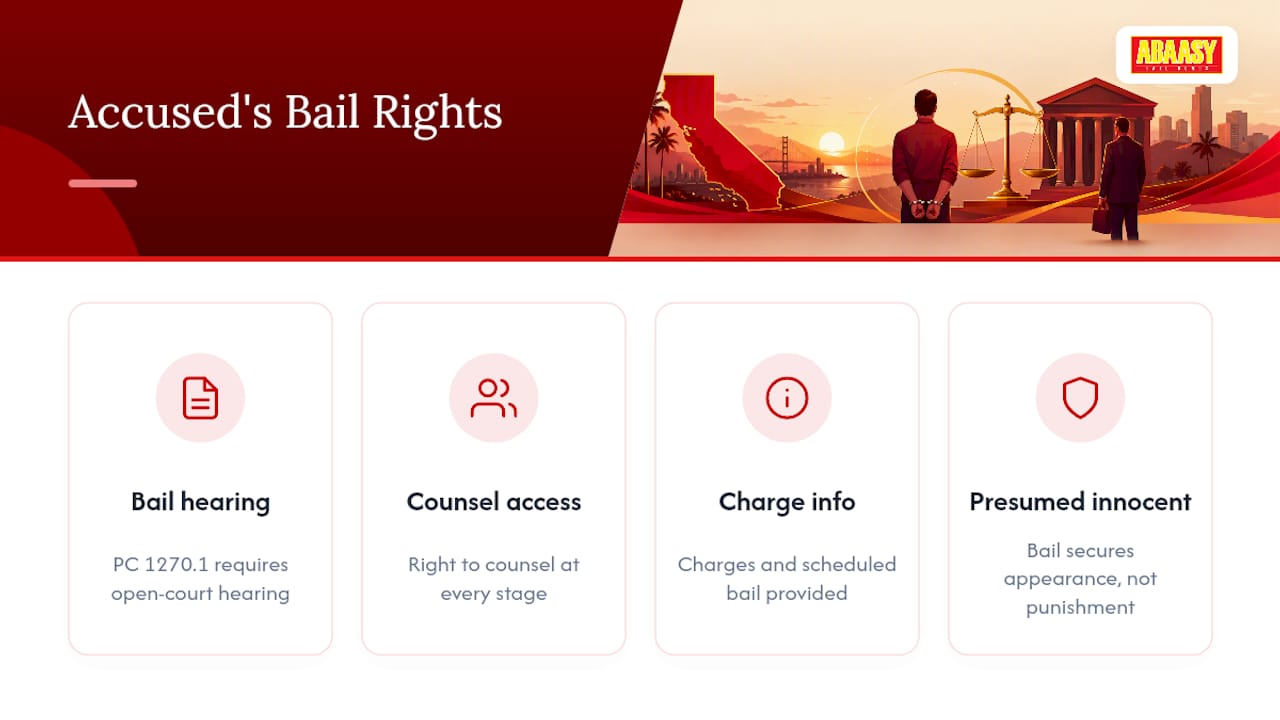
The right to a bail hearing is central. Under PC 1270.1, many domestic violence charges require an actual open-court hearing before a judge can deviate from the schedule, which means the accused gets a real opportunity to argue for a lower amount or OR release, not just a form filled out behind closed doors. The prosecutor must receive two court days' notice before that hearing, giving the defense a predictable window to prepare.
The right to counsel applies at every stage, including the bail hearing itself. An unrepresented defendant can request a public defender if one isn't already assigned, and waiting for that hearing without a lawyer present is rarely a good idea given how much weight the judge places on the evidence presented that day.
The right to be informed of the charges and the scheduled bail amount is also basic due process. Jail staff and court clerks are required to make that information available, and families can request it directly rather than guessing.
Finally, the accused retains the presumption of innocence throughout the bail process. Bail exists to secure appearance and protect safety, not to punish before conviction, and judges are supposed to weigh the statutory factors under PC 1275 rather than treat the arrest itself as proof of guilt. That distinction shapes how a defense attorney argues at the hearing.
How Does Bail Work Differently for Repeat Domestic Violence Offenders?
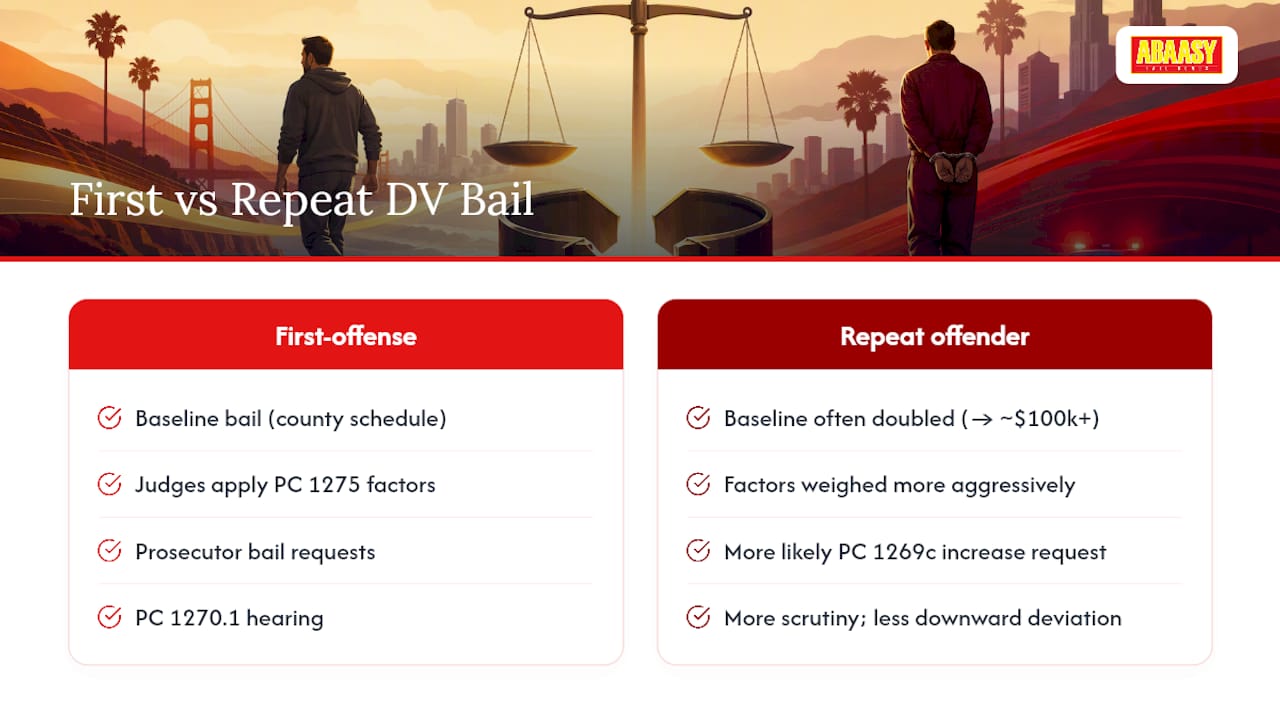
A prior domestic violence conviction changes almost every number in this process. County felony schedules routinely double the baseline bail amount for a second PC 273.5 offense, pushing figures toward $100,000 or higher where a $50,000 first-offense baseline would otherwise apply.
Judges also apply PC 1275's factors more aggressively when a criminal history exists. Prior convictions are one of the specific items judges must weigh, and a documented pattern of prior abuse tends to work strongly against any request for own recognizance release or a bail reduction. A prosecutor is far more likely to request a PC 1269c bail increase in a repeat-offense case, arguing that the schedule amount alone doesn't adequately protect the victim.
The PC 1270.1 hearing itself often looks different for repeat offenders. Expect more scrutiny of the safety plan, more direct questioning about compliance with any prior protective orders, and less willingness from the bench to deviate downward from the scheduled amount. Defense counsel representing someone with a prior DV conviction typically needs stronger documentation: completed batterer's intervention programs, consistent employment history since the last conviction, and clear evidence that no violations occurred during any prior supervision period.
Bail bond companies may also treat repeat cases differently, sometimes requesting additional collateral or a co-signer with stronger financial standing given the higher dollar amounts involved. None of this means release is impossible for a repeat offender, but every stage of the process moves slower and costs more.
Are There Alternatives to Posting Bail in Domestic Violence Cases?
Own recognizance release exists on paper for domestic violence charges, but it's granted far less often than in other case types precisely because PC 1270.1 requires that formal hearing and heightened scrutiny of victim safety before a judge will consider it.
Supervised OR release is a middle option some counties use, combining release without posting money with conditions like regular check-ins, electronic monitoring, or mandatory program attendance. Pretrial services programs, where available, assess a defendant's flight risk and community ties to make a release recommendation to the court, functioning as an alternative gatekeeper alongside the bail schedule itself.
Diversion programs are a separate track entirely, more relevant after arraignment than at the bail stage, but worth knowing about early since a defense attorney may raise eligibility at the same hearing where bail gets discussed. Not every domestic violence charge qualifies, and eligibility depends heavily on the specific facts and any prior record.
None of these alternatives are guaranteed, and in practice, most domestic violence defendants still end up posting bail or using a bond rather than securing OR release. The safety-focused framework built into California's statutes means judges default toward requiring a financial or supervised condition rather than releasing someone on their word alone.
How Does a Domestic Violence Arrest Affect Child Custody or Visitation?
A bail decision itself doesn't directly rule on custody, but the conditions attached to release often reach straight into a family's living situation. A criminal protective order issued alongside bail frequently includes a stay-away provision that can bar the defendant from the family home, which functionally decides where children live during the pretrial period even before any family court hearing happens.
Family court judges handling a related custody or visitation matter typically become aware of the criminal case, and a pending domestic violence charge is one of the factors they weigh when deciding temporary custody or supervised visitation arrangements. A stay-away order from the criminal case can override normal custody expectations until it's modified or the criminal case resolves.
This is exactly why quick, lawful release matters beyond just getting out of jail. A defendant still in custody has far less ability to participate in a family court hearing, retain custody counsel, or comply with any co-parenting logistics that come up during the case. Getting out promptly, with legal counsel already engaged, gives someone a realistic shot at addressing both the criminal case and any custody questions in parallel instead of falling behind on both fronts at once.
A Practical Perspective on Getting Through This
Safety and legal counsel come first, always. Bail isn't the finish line. It's a tool that reduces pressure so someone can consult an attorney instead of pleading out of desperation at arraignment. Bilingual, 24/7 licensed help with payment plans exists precisely because this process shouldn't wait on business hours.
— william
How Abaasy Bail Bonds Helps Families Move Fast
Once you know the charge and the scheduled bail, the next call matters more than any other decision in this process. Licensed bail agents are available across California, offering bilingual support and upfront pricing that skips the surprise fees consumer watchdogs warn about.

Payment plans mean the full premium doesn't have to come from one place at one time, which matters when a family is already dealing with a felony bail figure in the tens of thousands. Some bail bond companies handle misdemeanor and felony bail bonds, offer free inmate and warrant searches, provide consultations on PC 1275.1 holds, and coordinate directly with defense attorneys when a case calls for it. Understanding how bail bonds actually work in California before you call helps the process move faster once an agent picks up.
Before you dial, have the booking number, the full legal name, date of birth, the exact charge, and a photo ID ready. Visit Abaasy Bail Bonds or call for an immediate consultation to start the release process today.
Sources
- California Penal Code §1270.1
- Riverside County: Criminal Procedures / Bail increase and review
- Solano County bail schedule and bail calculation guidance (2026)
- Santa Barbara County felony bail schedule (sample entries)
- California Department of Insurance: Tips to avoid bail-agent scams
This article is general information, not a substitute for advice from a qualified lawyer. Consult a qualified legal professional about your own circumstances before acting on anything here.
FAQ
How much jail time comes with a domestic violence conviction in California?
Sentencing depends entirely on the charge and criminal history. A misdemeanor PC 243(e)(1) conviction can carry up to a year in county jail, while a felony PC 273.5 conviction can carry a multi-year state prison term, especially with prior convictions.
Can you bail yourself out of jail for a domestic violence charge?
Yes, if you have the full scheduled bail amount in cash, you can post it yourself without a bond. Most families use a licensed bail bond company instead, since it requires only a percentage of the total bail rather than the full amount upfront.
What are the penalties for a first-time domestic violence charge in California?
A first-time misdemeanor charge typically carries probation, mandatory batterer's intervention classes, and possible jail time up to a year, while a first felony PC 273.5 charge can bring probation with conditions or a state prison sentence depending on the injury involved.
How much is bail for assault in California when domestic violence is involved?
Misdemeanor domestic violence assault, such as PC 243(e)(1), commonly runs $10,000 to $20,000 on the county schedule, while felony domestic violence assault under PC 273.5 typically starts at $50,000 and rises with prior convictions or aggravating factors.