
Under California law, anyone jailed for want of bail is entitled to an automatic bail review within five days of the original bail order, under Penal Code §1270.2. The judge reconsiders whether the amount is fair, whether nonfinancial release fits the case better, and whether the person poses a genuine flight or safety risk. Only the defendant can give up this right, and no one else can waive it on their behalf.
TL;DR:
- The five-day bail review must occur promptly after the initial bail order, regardless of whether circumstances have changed, and only the defendant can waive this right.
- For serious or violent felony cases, prosecutors must give two days' notice before a reduction hearing, and judges must state reasons if they depart from standard bail in open court.
- Presenting concrete financial documents and a detailed supervision plan significantly increases the chances of bail reduction or nonfinancial release.
- Attorneys often secure better results by preparing documentation and arguments tailored to specific judges' preferences; legal counsel is highly recommended.
- If bail is not lowered, defendants can seek a later motion or legal remedy like a writ of mandate if the law was misapplied.
Table of Contents
- What Is a Bail Review Hearing in California?
- Understanding the Five-Day Right Under Penal Code §1270.2
- Special Rules for Serious and Violent Felonies
- What Happens at the Hearing and How Judges Decide
- How to Prepare: Documents That Actually Move the Needle
- Why Having a Lawyer at Bail Review Matters
- If the Court Denies Relief: What Comes Next
- Practitioner Perspective: Realistic Timelines After a Favorable Ruling
- Getting Out Fast After a Bail Review Ruling
- Where to Verify These Rules Yourself
- Sources
- FAQ
What Is a Bail Review Hearing in California?
A bail review hearing is a second look at a bail decision, separate from the arraignment where bail first gets set. At arraignment, judges often lean on a county bail schedule, which sets amounts for charges generally without detailed individual assessment. A bail review hearing exists to allow consideration of personal financial circumstances and other individual factors.
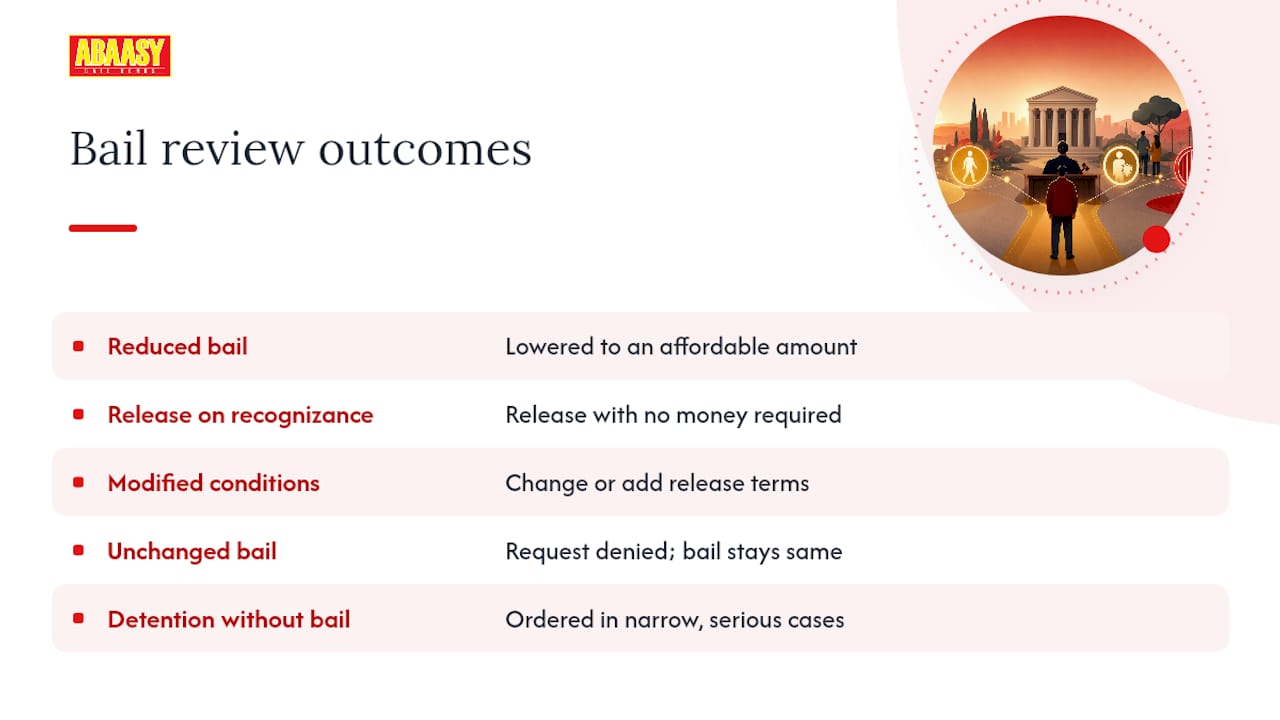
Judges at a review hearing generally choose from several possible outcomes, such as reducing bail to an affordable amount, granting release on recognizance (no money required), modifying release conditions, denying the request and keeping bail unchanged, or ordering detention without bail in narrow, serious cases where permitted by law.
The individualized review matters because of In re Humphrey, the 2021 California Supreme Court decision that reshaped how judges are supposed to think about bail. Before Humphrey, plenty of defendants sat in jail for weeks over amounts they simply couldn't raise, even when they posed no real danger. The court called that practice out directly, and a bail review hearing is where that correction actually gets applied to a real person's case.
Understanding the Five-Day Right Under Penal Code §1270.2
Penal Code §1270.2 says a court "shall" hold the review no later than five days after the order setting bail. That word choice matters. It's not a suggestion or a scheduling goal; it's a mandatory deadline built into the statute itself.
California Penal Code §1270.2 requires that the bail review hearing take place promptly following the original bail order, generally within a short statutory timeframe, with limited exceptions for court scheduling. Administrative delays do not eliminate the defendant's right to timely review.
Recent case law confirms this isn't just theory. In Bunker v. Superior Court (2025), a California appellate court reversed a trial judge who had denied a bail review request on the grounds that nothing had "changed" since the original order. The appellate court made clear that §1270.2 doesn't require a change in circumstances at all. The five-day review is automatic, full stop.
Defense attorneys can request the hearing on a client's behalf, but only the defendant personally can waive it. Judges cannot assume a waiver from silence.
Special Rules for Serious and Violent Felonies
Cases involving serious or violent felonies come with extra procedural armor, mostly found in Penal Code §1270.1 and Penal Code §1275. Lawmakers built these safeguards in because the stakes, both for public safety and for a defendant's liberty, run higher when the underlying charge is serious.
Here's what changes when the charge qualifies:
- The prosecution must give two court days' written notice before a hearing where bail could be reduced below the county schedule.
- Victims are entitled to notice of the hearing in cases where victim notification rules apply.
- Hearings on lowering bail below the schedule for these charges must happen in open court, not through an off-the-record phone call or chambers conference.
- Defendants who show up without a lawyer for one of these hearings are entitled to have counsel appointed before proceeding.
- Judges must state their reasons on the record whenever they depart from the standard bail schedule in a serious felony case.
That last requirement is the one prosecutors lean on hardest during appeal. If a judge lowers bail on a serious charge without a clear, recorded justification tied to what the law calls "unusual circumstances," the ruling becomes an easy target for reversal.
What Happens at the Hearing and How Judges Decide
A bail review hearing follows a fairly predictable rhythm, even though every case looks different once the facts come out.
- The case gets called, and the judge confirms who's present, defense counsel, prosecution, sometimes a victim or family member.
- The defense presents its argument first, typically walking through financial documents, community ties, and any proposed supervision plan.
- The prosecution responds, usually focusing on the seriousness of the charge, any prior record, and public safety concerns.
- The judge asks questions, often probing specifics: Where does the defendant work? Who lives in the household? Has anyone missed a prior court date?
- The judge rules, either from the bench immediately or after a short recess to review documents.
Judges weigh several factors side by side: how serious the alleged offense is, the defendant's criminal history, the realistic risk of flight, and public safety. Since Humphrey, they must also seriously consider the defendant's actual ability to pay, and they're supposed to prefer nonfinancial conditions unless detention is genuinely necessary. Courts can only detain someone purely on safety grounds when that necessity is shown by clear and convincing evidence, a high bar.
Victims sometimes testify or submit written statements, particularly in cases involving violence, and judges take that testimony seriously when deciding on release conditions.
Pro Tip: Bring a one-page written summary of your financial situation and community ties to hand the judge directly. Verbal arguments get forgotten in a busy courtroom; a document sitting in the judge's hand does not.

How to Prepare: Documents That Actually Move the Needle
Bail review hearings turn on paper as much as they turn on argument. Judges want to see concrete proof, not just a defense attorney's assurances, that a person will show up to court and won't pose a danger if released.
Financial documentation carries the most weight when arguing that a defendant genuinely cannot afford the bail amount set at arraignment:
- Recent pay stubs or proof of income
- Bank statements from the last two to three months
- Tax returns from the past year
- A written monthly budget showing rent, utilities, and other fixed bills
Community ties show a judge that someone has real reasons to stay put and show up to court:
- A signed lease or mortgage statement
- Employment verification letter from a current employer
- Proof of childcare responsibilities, such as school enrollment records for dependents
- Letters from family, employers, or clergy vouching for character and stability
Medical records matter too, particularly when a defendant is in active treatment for a condition that jail can't adequately manage. A doctor's letter documenting an ongoing prescription or therapy schedule can be persuasive on its own.
| Document Type | What It Proves | Who Typically Provides It |
|---|---|---|
| Pay stubs, bank statements | Genuine inability to pay set bail | Employer, bank |
| Lease or mortgage statement | Stable residence, low flight risk | Landlord, lender |
| Employment verification letter | Job stability and reason to return to court | Employer |
| Character reference letters | Community standing and support network | Family, clergy, employer |
| Proposed supervision plan | Concrete alternative to cash bail | Defense counsel, monitoring program |
A strong review request combines financial proof with a supervision plan, electronic monitoring, scheduled check-ins, enrollment in a community program, so the judge isn't just being asked to trust a promise. They're being shown an actual alternative to detention.
Why Having a Lawyer at Bail Review Matters
Defendants who show up with counsel tend to walk away with lower bail or nonfinancial release far more often than those who represent themselves, and that pattern holds without any corresponding rise in missed court dates. That gap exists because a defense attorney knows which documents a specific judge finds persuasive and how to frame a supervision plan so it reads as credible rather than desperate.
A defense lawyer typically spends the days before a hearing pulling records, drafting a declaration, and lining up character letters, then walks into court ready to counter whatever the prosecution raises about prior record or flight risk. That preparation is the difference between a hearing that feels rehearsed and one that feels like an afterthought.
If a defendant can't afford a lawyer and doesn't already have one appointed, they can ask the court directly for appointed counsel, particularly in serious felony cases where §1270.1 already requires it before certain hearings proceed. Requesting a short continuance to secure representation is also a reasonable ask, and judges generally grant it when the request is made in good faith rather than as a delay tactic.
If the Court Denies Relief: What Comes Next
A denial at the bail review hearing isn't necessarily the end of the road. Defendants and their attorneys have a few realistic paths forward.
- File a motion to modify bail later, especially if new facts emerge, a job offer, a stable living arrangement, or updated medical documentation that wasn't available at the first hearing.
- Petition for a writ of mandate, an extraordinary appellate remedy used when a trial court applies the law incorrectly rather than simply exercising reasonable discretion. Bunker v. Superior Court is a real example: the appellate court granted relief because the trial judge had misapplied §1270.2 by demanding changed circumstances that the statute doesn't require.
- Gather stronger evidence and request a new hearing, since courts are generally more receptive to a second request backed by documentation that wasn't presented the first time around.
Writ relief isn't for garden-variety disagreements over how a judge weighed the evidence. It's reserved for cases where the court got the legal standard wrong, not just where the outcome felt unfair.
Practitioner Perspective: Realistic Timelines After a Favorable Ruling
A favorable ruling doesn't mean instant release. Booking paperwork, jail processing, and internal verification can add hours, sometimes into the next shift change, before someone actually walks out. Families expecting a same-minute release are often the most frustrated by that gap, not because anything went wrong, but because jail administration runs on its own clock.
This is where coordination matters. A bail agent who already has paperwork ready when a judge lowers bail can move faster than one starting from scratch. County processing speed varies too. Some facilities move a released order through in under an hour; others routinely take most of a shift. Knowing your specific county's patterns saves real stress.
— william
Getting Out Fast After a Bail Review Ruling
Bail bond services exist for the moment right after a judge rules, when every hour in custody matters and paperwork delays feel unbearable. Unlike waiting on a public defender's caseload or navigating a courthouse clerk's office alone, a licensed agent reachable 24/7 can help families start the release process the minute bail is set or reduced.

The service covers emergency bail bonds across California, with bilingual support for Spanish-speaking families and no-interest payment plans that spread out the cost instead of demanding it all upfront. If a bail review hearing just reduced an amount that still feels out of reach, an agent can walk through exactly what a bond premium would cost and how quickly release can happen once the paperwork clears. Families who can't cover even a reduced bond might also look into bail assistance programs as a supplemental option.
Readers in the San Diego area can find county-specific help through the San Diego bail bonds page, and anyone elsewhere in the state can start the process directly at Abaasybailbonds.
Where to Verify These Rules Yourself
Every legal claim above traces back to a specific statute or ruling, and it's worth reading the primary source rather than taking any summary at face value:
- California Penal Code §1270.2 and the related §1270.1 provisions
- The appellate ruling in Bunker v. Superior Court
- Courts on pretrial procedure and bail factors
This article is general information, not a substitute for advice from a qualified lawyer. Consult a qualified legal professional about your own circumstances before acting on anything here.
Sources
- California Penal Code §1270.2
- Bail Review Hearing in California: How It Works — LegalClarity
- California Penal Code §1270.1 (Justia)
- Bunker v. Superior Court (Court of Appeal, 2025)
FAQ
How many bail reviews can you have?
There's no statutory cap. Beyond the automatic five-day review, a defendant can file additional motions to modify bail whenever new evidence, financial documents, medical records, or a stronger supervision plan, gives the court a real reason to reconsider.
What comes after a bail hearing?
If bail is reduced or OR release is granted, the next step is processing that release order through the jail, which can still take hours depending on the county. If bail is denied, the defense can pursue a later modification motion or, in cases of legal error, a writ of mandate.
What happens after a review hearing?
The judge's ruling gets entered into the court record and transmitted to the jail. From there, release processing begins if bail was reduced or granted, while a bail bond agent can typically move immediately once the new order is confirmed.
What are the new bail laws in California?
The biggest recent shift came from In re Humphrey and SB 262, which together require judges to consider a defendant's actual ability to pay and to favor nonfinancial release conditions unless detention is necessary for public safety. Recent appellate rulings like Bunker v. Superior Court have also reinforced that the five-day review under §1270.2 is automatic and not conditioned on changed circumstances.
Can a lawyer help lower bail at a review hearing?
Representation is strongly associated with better outcomes at bail review hearings, since attorneys know how to document ability to pay and present a credible release plan. Some bail bond services also work alongside defense counsel to speed up release once a judge issues a favorable ruling.