
Cash bail posted directly with a California court is generally refundable once the case ends, provided the defendant made every required appearance. A bail bond premium, the fee paid to a bail agent for posting a surety bond, is generally not refundable because it compensates the agent for taking on risk, not for holding your money. California regulations carve out a few narrow exceptions, but they're the exception, not the rule.
TL;DR:
- Refunds of cash bail are typically issued after case exoneration, but deductions for fines, fees, and administrative costs are common and may delay repayment.
- The bail premium paid to a surety is non-refundable because it compensates the agent for issuing the bond and is earned when the bond is posted, regardless of case outcome.
- Refunds outside the standard process are rare and usually only happen if the defendant is surrendered to custody or if the court grants a partial refund after forfeiture proceedings.
- Proper documentation, including original receipts and case disposition proof, is essential to expedite refund requests and resolve disputes over charges.
- Reputable bail agents document all charges beforehand, with transparent rates and clear receipts, to prevent overcharging and ensure families understand what they're paying for.
Table of Contents
- Bail Refund vs Premium: How Cash Refunds Actually Work
- Why a Bail Bond Premium Isn't Refundable
- When Refunds and Reduced Premiums Actually Happen
- What to Do If You're Chasing a Refund or Disputing a Charge
- How Abaasy Bail Bonds Handles Premiums and Refund Questions
- The Gap Between What the Law Says and What Families Expect
- Need Bail Help Right Now? Here's How Abaasy Bail Bonds Can Step In
- Where to Verify the Law Yourself
- Sources
- FAQ
Bail Refund vs Premium: How Cash Refunds Actually Work
Posting cash bail means you hand the full bail amount to the court clerk, not to a bail agent. That distinction matters because it determines who controls the money and who eventually gives it back.
When the case wraps up, whether through dismissal, acquittal, plea, or sentencing, the court "exonerates" the bail. At that point, the person who posted the money can request a refund. Some counties issue it automatically; most require the depositor to file a claim with proof they were the one who paid.
Deductions are common and often catch families off guard. Courts routinely subtract:
- Outstanding fines, restitution, or court fees ordered as part of the case
- Administrative processing costs charged by the county clerk's office
- Any amount tied to a partial forfeiture if a court date was missed and later reinstated
According to attorney guidance on bail money after case dismissal, refund timelines vary significantly by county, and some jurisdictions take weeks longer than others to process the paperwork. Requesting a clerk's certificate confirming the case disposition speeds things up considerably, since it gives the depositor documented proof the case is closed and the bail is eligible for release.
Pro Tip: Keep the original receipt from the day you posted cash bail. Without it, some clerk's offices will delay your refund while they verify who actually paid.
Why a Bail Bond Premium Isn't Refundable
A premium is not a deposit. It's the price you pay a licensed surety company to guarantee the full bail amount to the court on your behalf. Once the agent posts that bond, the service they're being paid for is complete, whether the case lasts one week or two years.
That's the core difference between premium and collateral. Collateral, property or assets pledged to secure a large bond, gets returned once the bond is exonerated and the agent's obligations end. Premium doesn't work that way. The Insurance Commissioner's overview of California's bail system confirms premium is earned at the moment the bond is issued, not spread out over the length of the case.
California regulators also tightly control how much an agent can charge and how they're allowed to describe that charge. Under 10 CCR 2081 and 2094, agents must charge the rate their surety company has filed with the state, not whatever number they negotiate on the spot. On top of that:
- Agents cannot invent extra "processing" or "convenience" fees outside the filed rate
- Any additional charges must fall under a specific, regulated category, such as actual transaction expenses
- The Department of Insurance's Bulletin No. 137 treats the full amount collected on the undertaking as reportable premium, which limits how creatively an agent can label what you paid
Checking the actual bond paperwork, called the undertaking, against the rate an agent quoted verbally is one of the simplest ways to confirm you were charged correctly.
When Refunds and Reduced Premiums Actually Happen
Refunds aren't impossible outside the standard cash bail process. They're just rare, discretionary, and usually tied to specific legal circumstances.
- Surrender to custody. A person who posted bail, or the surety itself, can surrender the defendant back into custody before the case concludes. Under California Penal Code surrender provisions, the court then has discretion to order the return of some or all of the premium or deposit paid, but that outcome is never guaranteed.
- Court discretion after documented surrender. These motions typically require a formal record of the surrender and five days' notice to the district attorney before a judge will consider ordering money returned.
- Forfeiture and reinstatement. If a defendant misses a court date, the bond can be forfeited. California law then gives a window, often 180 days plus extensions, for the surety to locate and surrender the defendant to have the forfeiture set aside. Costs tied to that search, sometimes called breach expenses, get charged against whatever might otherwise be refunded.
Even when a judge grants a partial refund after surrender, expect administrative costs to be subtracted first. Nobody walks away with a clean, full return once forfeiture proceedings have already started.
What to Do If You're Chasing a Refund or Disputing a Charge
Start gathering documentation the moment bail is posted, not after the case ends. Waiting to organize your paperwork is the single biggest reason refund requests stall in county systems.
- Keep every receipt. This includes the original bail receipt, any court paperwork showing case disposition, and the undertaking document if a bond was involved.
- Request a clerk's certificate. Once the case is resolved, ask the court clerk's office for written confirmation of the disposition. Most counties require this before releasing a cash refund.
- Contact the right party for the right issue. For cash bail delays, call the court clerk. For a dispute over premium charges or fees that seem outside the filed rate, contact the surety company directly, and escalate to the California Department of Insurance if the agent won't resolve it.
- Talk to an attorney if money was forfeited. Forfeiture disputes and surrender motions involve court filings that most families shouldn't navigate alone.
Pro Tip: If an agent's fee doesn't match the percentage written on the undertaking, ask to see the filed rate sheet. It's a fast way to confirm whether you were overcharged.
How Abaasy Bail Bonds Handles Premiums and Refund Questions
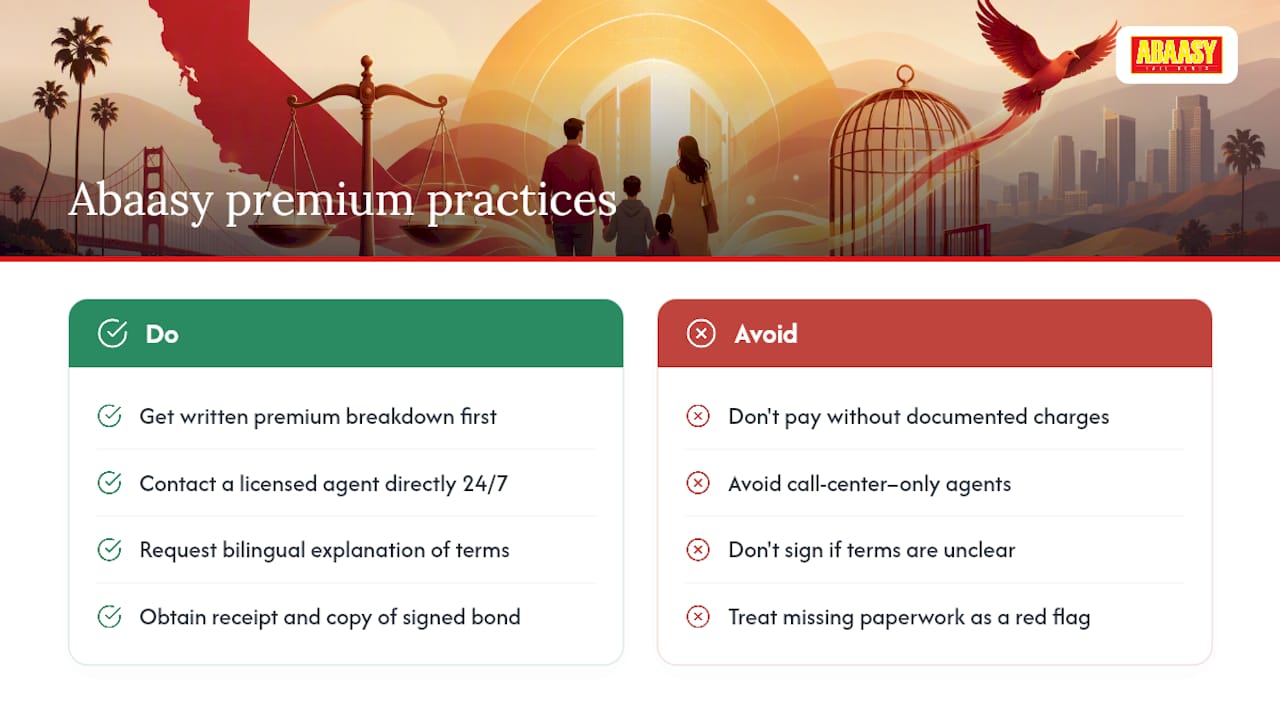
Reputable agents document everything before a dollar changes hands. That means a written breakdown of the premium, the filed rate it's based on, and any permitted additional charges, before the bond is signed.
Clients reach a licensed agent directly, 24/7, rather than a call center, which matters when someone's arrested at 2 a.m. and the clock on release is already ticking. Bilingual support helps ensure the person signing the agreement understands what premium means, what's refundable, and what isn't, before they commit.
A clear receipt and a copy of the signed bond paperwork should be part of what you receive. If documentation isn't provided upfront, that's worth treating as a red flag.
The Gap Between What the Law Says and What Families Expect
Most people assume "bail" is one thing, money you get back when the case is over. That assumption is where the confusion starts, and it's not really the public's fault. Court paperwork rarely spells out, in plain terms, that a premium and a deposit are legally and functionally different animals.
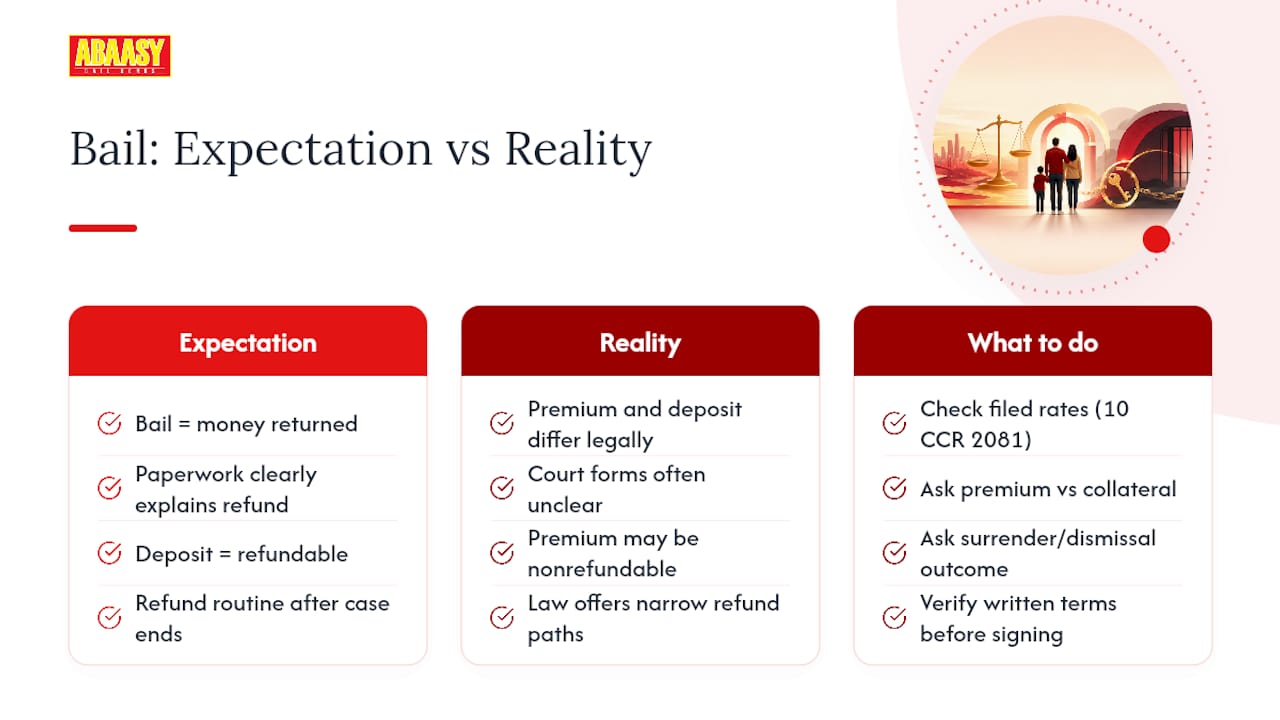
The conventional advice, "just read your paperwork," isn't wrong, but it's incomplete. Filed rates under 10 CCR 2081 exist precisely because verbal quotes and undertaking documents don't always match, and most families have no idea they're entitled to check.
If there's one thing worth prioritizing, it's asking questions before signing, not after. Ask what's premium, what's collateral, and what happens if the case gets surrendered or dismissed early. The law gives you narrow paths to a refund. Knowing they exist before you need them is the only real advantage.
— william
Need Bail Help Right Now? Here's How Abaasy Bail Bonds Can Step In
If you're weighing cash bail against a bond and need assistance promptly, some companies build their services around exactly that pressure point. Calls reach licensed agents directly, day or night, often with upfront pricing provided before commitment.

Families dealing with an unexpected arrest can lean on 24/7 Emergency Bail, no-interest payment plans that avoid piling debt on top of an already stressful situation, and a free inmate and warrant search if you're not even sure where a loved one is being held. Some bail bond companies offer dedicated consultations for navigating Penal Code 1275 hold processes. Readers in that region can also check the San Diego bail bonds page for local availability. Contact a bail bond service to get a clear, written breakdown of your premium before signing.
Where to Verify the Law Yourself
- 10 CCR 2081 and 2094 on filed premium rates, covering what agents can and cannot charge
- California Department of Insurance Bulletin No. 137, defining premium on bail undertakings
- California Penal Code surrender provisions, governing court discretion over refunds after surrender
- M&J Bail Bonds' explainer on what happens to bail money, a practical outside perspective on the cash versus premium split
This article is general information, not a substitute for advice from a qualified lawyer. Consult a qualified legal professional about your own circumstances before acting on anything here.
Sources
- STATE OF CALIFORNIA DEPARTMENT OF INSURANCE BULLETIN NO. 137 — “PREMIUM” ON UNDERTAKING OF BAIL
- California Penal Code — surrender and court actions (leginfo)
- What happens to my bail money if the case gets dismissed in San Diego? | David P. Shapiro Law
FAQ
Is a Bail Bond Refundable in California?
No. A bail bond premium is generally not refundable once the surety posts the bond, since it's payment for a service already rendered. Cash bail paid directly to the court, by contrast, is typically refundable when the case ends and all appearances were met, as explained in attorney guidance on California bail refunds.
What's the Difference Between Bail Refund and Premium?
A bail refund applies to cash deposited directly with the court, which comes back once the case is resolved, minus any fines owed. A premium is the nonrefundable fee, typically a percentage of the total bail, paid to a bail agent for issuing a surety bond.
Can I Get My Premium Back if the Case Is Dismissed?
Generally, no. The premium compensates the surety for guaranteeing the bond regardless of how the case ends, whether it's dismissed in a day or drags on for a year.
How Long Does a California Bail Refund Take?
Timelines vary by county, and some clerk's offices process refunds faster than others. Requesting a clerk's certificate confirming case disposition typically speeds up the process.
What Does Abaasy Bail Bonds Charge for a Bond?
Some companies provide upfront pricing based on filed rates and offer no-interest payment plans for families needing flexibility. Exact pricing details are available directly through Abaasy Bail Bonds.