

For the fastest release with the least cash out of pocket, call a licensed bail bondsman. You typically pay a 10% premium instead of the full bail amount. If you can gather the entire bail sum, Penal Code §1295 lets you post cash bail directly with the court clerk and get it back later, minus nothing if the case resolves cleanly and every court date gets kept.
TL;DR:
- Bail bonds typically cost around 10% of the bail amount as a non-refundable premium, which agents can often post within an hour.
- Cash bail requires paying the full bail amount directly to the court clerk, with refunds issued only after case resolution and attending all court dates.
- Property bonds usually take days for appraisals and are unlikely to enable same-night release due to paperwork delays.
- A bail reduction or recognizance release depends on court scheduling and cannot usually be arranged within the same night.
- Calling a licensed 24/7 bail bondsman is faster for immediate release, with transparent pricing and flexible payment plans, compared to waiting for court hearings.
Table of Contents
- Quick Comparison: Which Option Gets Someone Out Tonight?
- How Do You Use a Bail Bondsman to Get Someone Out Fast?
- How Do You Post Cash Bail Under Penal Code §1295?
- What Do Bonds and Cash Bail Actually Cost?
- What Risks Should You Watch for During an Emergency Bail?
- How Can You Lower the Cash You Need Tonight?
- What Does the Timeline Look Like From Arrest to Release?
- How Do You Actually File a Motion to Ask the Court for a Lower Bail Amount?
- What Do Judges Actually Consider When Weighing These Requests?
- Are There Standard Forms for Requesting a Lower Bail Amount?
- How Should You Work With an Attorney or Public Defender on This?
- What Happens if You Need Help Outside Normal Court Hours?
- What Families Should Actually Expect When They Call
- Get Someone Home Tonight With a Licensed California Agent
- Verify the Rules Yourself
- Sources
- FAQ
Quick Comparison: Which Option Gets Someone Out Tonight?
Every route to release trades speed against cash. A bail bondsman wins on upfront cost. Cash bail wins on getting your money back. Here's how the main options stack up when you're trying to move fast:
- Bail bond (surety bond): Requires a non-refundable premium set by filed rates with the California Department of Insurance, commonly described as about 10% of the bail amount. A licensed agent can often post it within the hour, and some agents accept collateral instead of cash for part of the fee.
- Cash bail under PC §1295: Requires the full bail amount, paid directly to the court clerk. It's refundable at case end, but you need every dollar today, not a fraction of it.
- Property bond: Uses real estate equity, usually at least twice the bail amount, to secure release. Appraisals and title paperwork mean this route rarely moves fast enough for a same-night release.
- Release on recognizance (OR) or attorney-requested reduction: Can eliminate or shrink the bail requirement entirely, but it depends on a judge's calendar and isn't something you control by making a phone call tonight.
If speed and low cash both matter, the bondsman route usually wins. If you happen to have the full amount sitting in a bank account and don't mind waiting weeks or months for a refund, cash bail avoids paying anyone a fee at all.
How Do You Use a Bail Bondsman to Get Someone Out Fast?
The process moves in a predictable order, and most of the delay comes from paperwork, not the agent.
- Confirm the jail, charges, and bail amount. Use the county's inmate locator, or call the facility directly. You'll need the booking number and case number before anyone can help you.
- Call a licensed 24/7 bail agent. Provide the defendant's full legal name as booked, the booking number, the charges, and the bail amount. Ask upfront what payment forms they accept and whether collateral is required.
- Sign the indemnity agreement. You'll provide ID, pay the premium (or set up a payment plan), and put up collateral if the agent asks for it. Get a signed receipt before you hang up or leave the office.
- The agent posts the bond with the court or jail. Processing time varies by facility, but a responsive agent working with a responsive jail often gets someone released within the hour.
- Verify the license before you pay anything. Check the agent's standing with the California Department of Insurance — an unlicensed person cannot legally post a valid bond, and paying one solves nothing.
Pro Tip: Save a screenshot of the agent's license lookup result alongside your payment receipt. If a dispute comes up later about fees or collateral, you'll want both in the same place.
How Do You Post Cash Bail Under Penal Code §1295?
Cash bail is the statutory alternative to a bondsman, and it works differently enough that it deserves its own walkthrough.
Under PC §1295, you or a representative can deposit the full bail amount directly with the court clerk. The defendant gets released once the deposit clears, and the money comes back at case resolution as long as every court appearance is kept.
- Bring the booking number and case number. Clerks need both to process the deposit correctly.
- Payment methods vary by county. Most clerks take cash, cashier's checks, or money orders, and some accept cards with a processing fee. Call ahead to confirm what your specific courthouse allows.
- Deposits over $10,000 in cash can trigger federal reporting requirements, so expect extra paperwork if you're paying in physical currency.
- Keep every receipt. You'll need it to claim your refund once the case closes, and refund processing can take weeks to months depending on the county.
What Do Bonds and Cash Bail Actually Cost?
The premium on a California bail bond is commonly 10% of the bail amount, and surety companies file those rates with the California Department of Insurance rather than setting them arbitrarily. That premium is gone the moment you pay it, whether the case ends in dismissal or conviction.
Cash bail flips that equation.
Card processing fees on cash bail deposits are often non-refundable even after the underlying cash comes back. Payment plans on a bond premium spread the cost across months. They don't lower the total you owe. Refund and forfeiture timelines differ by county, so a quick call to the court clerk beats guessing.
What Risks Should You Watch for During an Emergency Bail?
Move fast, but don't skip these checks. A missed premium payment on a financed plan can lead the agent to surrender the defendant back into custody, and the bond gets forfeited in the process.
- Verify licensing with the California Department of Insurance before you sign anything or hand over payment.
- Get every term in writing, including what happens if a court date is missed.
- Ask who holds your collateral and how long it takes to get it back after the case closes.
- Understand that forfeiture can expose co-signers, not just the defendant.
Pro Tip: Ask the agent directly: "What's your process if a payment is late by one day?" A reputable agent answers that question without hesitation. One who dodges it is a red flag.
How Can You Lower the Cash You Need Tonight?
A few moves can shrink what you need to pay right now, even under time pressure.
- Ask for documented payment-plan terms. A written plan spreads the premium cost over time, though it won't reduce the total owed.
- Have an attorney push for a bail reduction or OR release at arraignment. A lower bail amount directly lowers the premium you owe on a bond.
- Ask about referral discounts filed with the surety. Some attorneys have arrangements that legitimately reduce the premium rate, but only if the surety has filed that rate with the state.
- Consider a property bond if cash is truly unavailable. Expect days of appraisal and title work, so this only helps if the timeline allows for it.
What Does the Timeline Look Like From Arrest to Release?
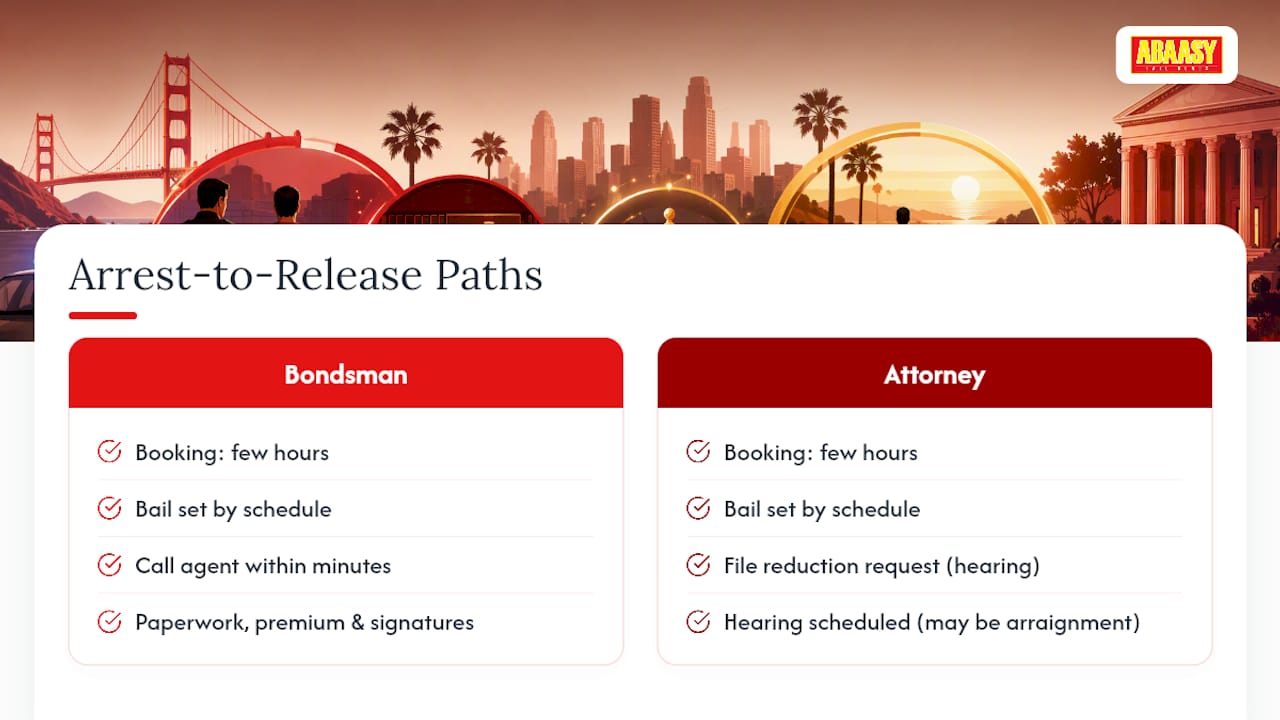
Most families lose time not because the paperwork is slow, but because nobody has gathered the basic facts yet. Arrest to booking usually takes a few hours, during which the jail assigns a booking number and sets bail according to the county's bail schedule unless the charge requires a judge to set it directly.
Once bail is set, the clock really starts. If you call a licensed bondsman right away, the agent can often begin paperwork within minutes of that call, and the actual bond gets posted with the jail once premium payment and indemnity signatures are complete. Release itself depends on how busy the facility is. Some jails process paperwork in under an hour; others, especially on weekends or during shift changes, can take several hours regardless of how fast the bondsman moves.
If an attorney is pursuing a bail reduction instead of paying full price, that timeline stretches out. A reduction request typically needs a scheduled hearing, which might happen at arraignment (usually within 48 hours of arrest, excluding weekends and holidays) rather than same-day. That's why most families pursuing a same-night release use a bondsman first and let an attorney address the bail amount afterward if the case continues.
The fastest realistic path: confirm booking details, call an agent, complete paperwork, and let the agent handle posting. The slowest path: waiting on a court hearing you can't schedule on your own timeline.
How Do You Actually File a Motion to Ask the Court for a Lower Bail Amount?
Reducing bail amounts is a legal process handled through the courts, and it runs on a separate track from your immediate release options. It starts with a written request filed by the defendant's attorney, laying out why the current bail amount is excessive given the charges, the defendant's ties to the community, and any flight or safety risk factors.
The attorney typically files that request with the same court handling the criminal case, and a hearing gets scheduled. Prosecutors usually get notice and can argue against the reduction, especially for serious felony charges. The judge reviews the request at a scheduled hearing rather than ruling on paperwork alone.
Because this process depends entirely on court scheduling, it isn't something you can complete in an evening the way you can with a bondsman or cash deposit. For most families dealing with an urgent same-night situation, the practical move is to secure release first through a bond or cash deposit, then have an attorney evaluate whether pursuing a lower bail amount makes sense given the length and complexity of the case ahead.
What Do Judges Actually Consider When Weighing These Requests?
Judges look at a handful of consistent factors when deciding whether to lower a bail amount, and they aren't guessing. They weigh the severity of the charges, the defendant's criminal history, ties to the community such as employment and family, and any documented flight risk.
Public safety factors carry real weight too, particularly for charges involving violence or firearms. A defendant with strong community ties, a clean record, and a stable job presents a different picture than someone with prior failures to appear.
Financial hardship on its own rarely moves a judge without those other factors also pointing toward release. That's part of why attorney involvement matters. A well-documented request that addresses the judge's actual concerns tends to fare better than a bare request that simply states the amount is too high. This is also why families who can't wait on that process often move forward with a bondsman while the legal side plays out separately.
Are There Standard Forms for Requesting a Lower Bail Amount?
There isn't one universal statewide form. Requests are typically drafted by the defendant's attorney as a written motion specific to the case, the charges, and the county's local court rules.
Some public defender offices and county courts maintain internal templates their own attorneys use, but these aren't typically available as public downloads because they're tailored to case specifics like charge codes and factual arguments unique to each defendant. If you're working with a private attorney, they'll draft this document as part of their representation rather than pulling a generic form off a website.
If you're representing yourself, which is uncommon in bail matters, court self-help centers in some counties can point you toward local procedural rules, though the actual written argument still needs to address the judge's real concerns rather than following a fill-in-the-blank template. This is one more reason most families lean on either a public defender or private counsel for this specific step, while handling immediate release through a bondsman in parallel.
How Should You Work With an Attorney or Public Defender on This?
Whether you have a public defender or private counsel, come prepared with specifics. Attorneys move faster when you hand them concrete details instead of a general request for help.
Bring the booking number, case number, charges, and any documentation showing community ties: proof of employment, a lease or mortgage, family relationships, or enrollment in school. If there's a prior record, be upfront about it. Attorneys build stronger arguments when they aren't blind sided by information the prosecution already has.

Ask your attorney directly whether pursuing a bail reduction makes sense given the timeline you're facing. In some cases, the cost of a bondsman's premium is small compared to the bail amount, and waiting days for a hearing doesn't make financial sense. In others, particularly with higher bail amounts, a reduction hearing can meaningfully cut what you'd otherwise pay. A good attorney will walk through that math with you rather than pushing one option by default.
What Happens if You Need Help Outside Normal Court Hours?
Courts don't run 24/7, which is exactly why most families end up using a bondsman for immediate release rather than waiting on a hearing. If someone is arrested on a Friday night, a bail reduction hearing realistically isn't happening until the next business day at the earliest, and often not for several days depending on the court's calendar.
This gap is the main reason licensed bail agents operate around the clock while the court system doesn't. A 24/7 bondsman can begin paperwork the moment you call, regardless of the hour, while any request to lower the bail amount waits for the court to reopen. If your priority is getting someone out of custody tonight, that timing difference usually settles the decision on its own, with the legal question of a lower bail amount becoming a next-day conversation with an attorney.
What Families Should Actually Expect When They Call
Most guides gloss over what a phone call to a bail agent actually feels like at 2 a.m. Licensed bail bond agents work around the clock and often aim for quick releases when the jail cooperates. Expect bilingual, empathetic support and clear pricing upfront, not a number that shifts once you're already committed. Always ask for license confirmation and a written receipt. Keep a short list ready before you dial: the inmate's name, booking number, facility, bail amount, and how you plan to pay.
— william
Get Someone Home Tonight With a Licensed California Agent
Licensed bail bond agents handle the part of this process many families dread: the paperwork, the phone tag with the jail, and uncertainty about payment plans. Unlike waiting on a court hearing to lower a bail amount, calling a licensed agent gets the process moving immediately, with transparent pricing and flexible, no-interest payment plans instead of a lump sum you may not have tonight.

Bail bond agents post bonds across California, including San Diego County, Riverside County, and San Bernardino County, with agents available at any hour. Before you call, gather the booking number, the facility name, and the bail amount so the agent can move quickly on your behalf. Visit Abaasy Bail Bonds or call now to speak with a licensed agent and start the release process.
Verify the Rules Yourself
For the statutory basis of cash bail, read Penal Code §1295 directly. For agent licensing and filed rates, check the California Department of Insurance.
This article is general information, not a substitute for advice from a qualified lawyer. Consult a qualified legal professional about your own circumstances before acting on anything here.
Sources
- California Legislative Information — Penal Code §1295
- California Department of Insurance — Bail bonds
- LegalClarity — Can you bail yourself out of jail in California?
FAQ
Is a Bail Bond or Cash Bail Faster in California?
A bail bond is almost always faster because a licensed agent can begin paperwork immediately with a fraction of the total bail amount, while cash bail requires you to produce the full sum before the clerk processes release.
How Much Does a Bail Bondsman Charge in California?
Bail bond premiums are commonly 10% of the total bail amount, filed as a rate with the California Department of Insurance, and that fee is non-refundable regardless of the case outcome.
Can I Get My Money Back if I Pay Cash Bail?
Yes, cash bail deposited under Penal Code §1295 is refundable once the case resolves, as long as the defendant attends every required court appearance.
How Do I Know a Bail Agent Is Actually Licensed?
Check the agent's license status directly through the California Department of Insurance before paying anything or signing an indemnity agreement.
Can Bail Bonds Help Outside Normal Business Hours?
Yes, licensed bail agents operate 24/7 across California and work to post bonds quickly, often achieving release within the hour when the jail is responsive.
What Information Do I Need Before I Call a Bondsman?
Gather the defendant's full legal name, the booking number, the facility name, the charges, and the bail amount before making the call to speed up processing.