
Most bail agents accept cash, credit or debit cards, cashier's checks, money orders, bank wires, and person-to-person apps like Zelle or PayPal, though every agency sets its own mix. The one fact that trips people up: the premium you pay a bail agent is generally nonrefundable, unlike cash bail paid straight to a court. Larger bonds often require collateral, and the exact rules shift by state.
TL;DR:
- Most bail agents accept multiple payment methods, but cash and cashier's checks are fastest when paying in person, while online payments require caution to avoid scams.
- Payment plans typically involve a down payment plus installments, with conditions including creditworthiness and the risk of bond revocation if payments are missed.
- Collateral may be required for larger bonds and becomes subject to liens; bail premiums are non-refundable once paid to the agent, while court-placed cash bail is refundable after case resolution.
- Verifying the legitimacy of online payment portals involves HTTPS, official agency domains, and direct confirmation with official court or jail contacts.
- Quick bail posting relies on having booking details, ID, and asking licensed agents about accepted methods and processing times, especially for smaller bonds.
Table of Contents
- What Bail Bond Payment Methods Are Accepted?
- How Do Bail Bond Payment Plans and Financing Work?
- Do You Get Collateral or Money Back After the Case Ends?
- How Do I Pay Bail Online Safely?
- What's the Fastest Way to Post Bail Right Now?
- What Families Actually Need When Everything Is Moving Fast
- Ready to Post Bail? Here's How Abaasy Bail Bonds Helps
- Where to Verify Bail Bond Rules and Payment Terms
- Sources
- FAQ
What Bail Bond Payment Methods Are Accepted?
Every payment route has its own speed and its own fine print, and the fastest one on paper may not always be the fastest one in practice.
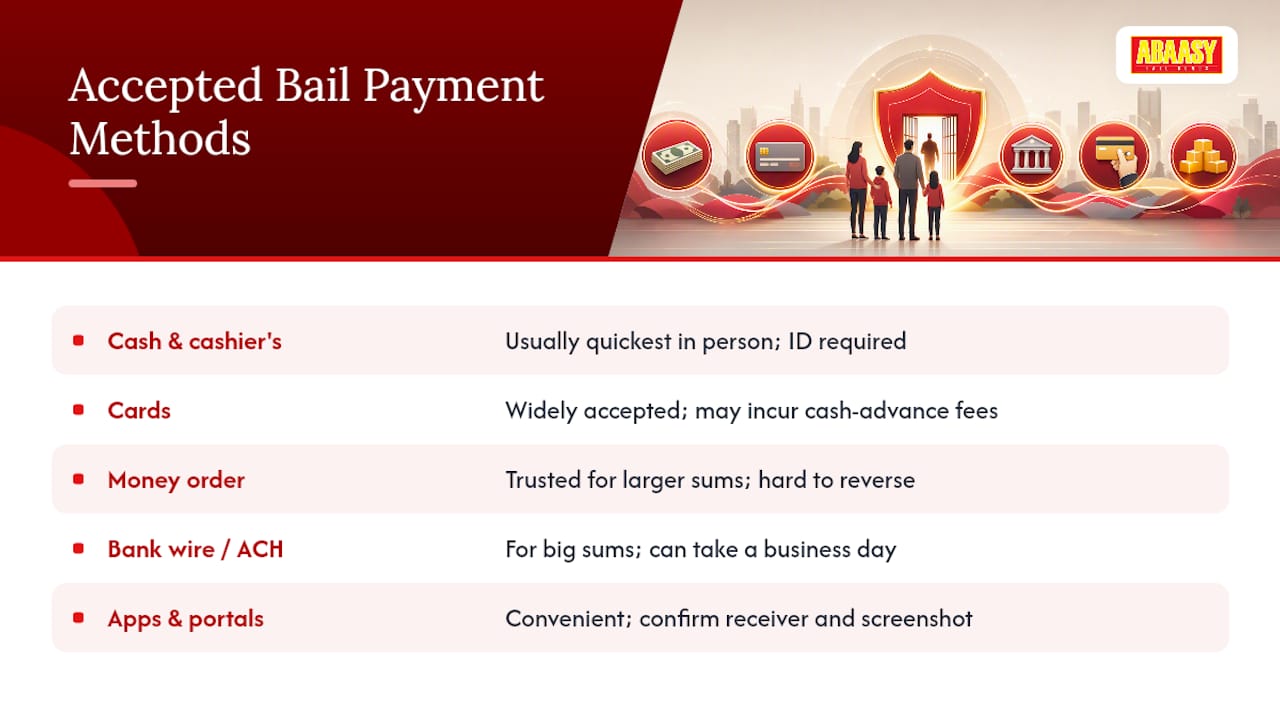
Paying in person at the agency or jail lobby is usually the quickest way to close things out. Cash and cashier's checks move fastest here because there's nothing to verify after the fact, but you'll need a valid photo ID and the office needs to actually be open.
Credit and debit cards are widely accepted, but some agencies or county systems process them as cash advances, which can tack on extra fees your card issuer charges, not the bail agency. Expect to show ID that matches the card, since agents limit electronic payments to control chargeback risk.
Money orders and cashier's checks work well for larger amounts because they're harder to reverse than a personal check, and both courts and agents tend to trust them.
Bank wires or ACH transfers handle bigger sums but take longer to clear, sometimes a full business day. They leave a clean paper trail, which matters if a dispute ever comes up.
Zelle, PayPal, or Cash App payments are convenient for smaller amounts, but confirm the agent actually uses that specific app before sending anything, and always screenshot the confirmation.
Some courts and jails now run their own payment portals separate from any bail agent, accepting cards or ACH directly through an approved processor.
How Do Bail Bond Payment Plans and Financing Work?
A payment plan changes when you pay, not what you owe. The premium is the agent's fee for posting the bond, and that obligation exists whether you pay it in one shot or over six months.
Here's how most plans break down:
- Down payment plus installments – you pay a portion upfront, then pay the rest on a schedule.
- Promotional low-down offers – some agencies offer low initial down payments, typically reserved for clients with steady income or a co-signer.
- Zero-interest arrangements – some agencies provide flexible plans without charging additional interest.
Eligibility usually hinges on credit history, employment, the charges involved, and whether a co-signer is willing to back the agreement. Miss an installment, and the fallout isn't just a late fee. Agencies can revoke the payment plan and surrender the defendant back into custody, and any collateral pledged can face a lien or seizure.
Pro Tip: Get every term of a payment plan in writing before you sign anything, including whether fees apply and whether paying early gets you any discount. A verbal promise from an agent means nothing if a dispute lands in court. For a full breakdown of how these arrangements typically work, see this guide to bail bond payment plans.
Do You Get Collateral or Money Back After the Case Ends?
Collateral only enters the picture for larger or higher-risk bonds, and it can take several forms: a deed to real estate, a vehicle title, jewelry, or stocks. Agencies typically file a lien against property used this way, which stays in place until the bond obligation is fully resolved.
Refunds work differently depending on what you paid and to whom:
- Cash bail posted directly with the court is refundable once the case is resolved through exoneration, usually minus a small administrative fee.
- The premium paid to a bail agent is a service fee for the work of posting the bond, and it's not returned even if charges are dropped.
- Collateral gets released only after the case concludes and every payment obligation under the agreement is satisfied.
State insurance departments, like California's, regulate how these premiums are set and disclosed, which is worth checking if an agency's terms sound off. And if the defendant skips a court date, the indemnitor who signed the agreement remains on the hook for the full bond amount, with the agency free to pursue both the person and any pledged collateral.
How Do I Pay Bail Online Safely?
Online bail payment is increasingly common, but it's also where scams tend to concentrate. Before you enter any card number, check for a few basics.
- Confirm the site uses HTTPS and matches the actual court, jail, or licensed agency domain, not a lookalike.
- Call the county clerk's number listed on the official government site to confirm the portal is real.
- Verify the agent's license through your state's insurance or financial services department before sending money.
- Have the booking number, case number, defendant's full legal name, and exact bail amount ready. Most legitimate portals require all four before processing anything.
- Save every transaction ID, confirmation email, and receipt in one place.
Red flags include unsolicited text links asking for payment, or anyone pushing you toward an unusual payment app you've never used. Pro Tip: If a "bail agent" contacts you first and demands payment through a personal Venmo or gift cards, stop immediately. Legitimate agencies never ask for payment that way.
What's the Fastest Way to Post Bail Right Now?
Under time pressure, having the right details ready saves more time than any single payment method.
- Write down the booking number, the defendant's full legal name, the exact bail amount, and the court or case number.
- Have a valid photo ID for whoever is paying.
- Call a licensed 24/7 agent and ask three things directly: what payment types they accept, how much down payment is required, and how soon they can post the bond.
- If paying in person, bring cash or a cashier's check for speed; if paying by card, confirm ID requirements first.
- After payment, get a copy of the receipt and call the jail or court to confirm the expected release window.
Smaller bail amounts, a few hundred to a few thousand dollars, typically move fast through card or cash. Larger bonds often trigger collateral requirements that slow things down with appraisals and paperwork.
What Families Actually Need When Everything Is Moving Fast
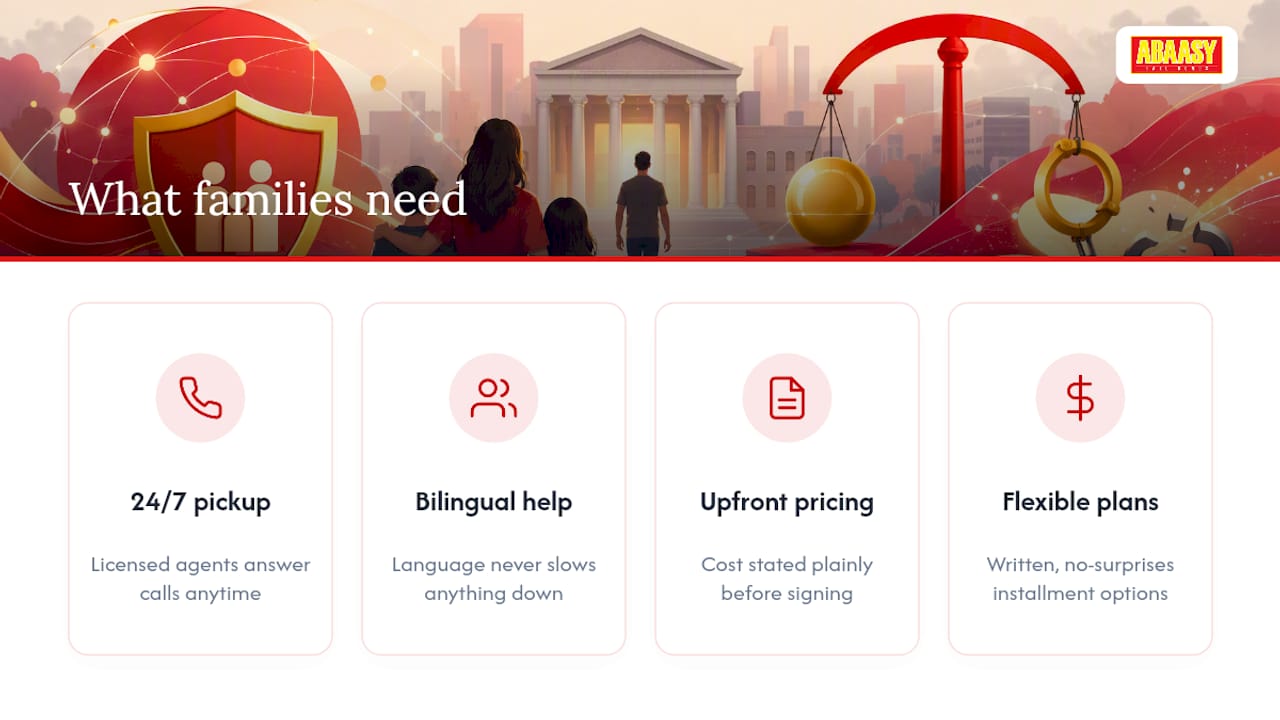
Families calling in the middle of the night aren't looking for a lecture on how bail works. They want someone who picks up the phone, tells them the real cost upfront, and moves. Some bail bonds agencies build their process around exactly that pressure point: licensed agents answering calls 24/7, bilingual support so language never slows anything down, and pricing that's stated plainly before anyone signs.
Flexible payment plans matter here too. A family that can't produce the full premium in cash at 2 a.m. still needs a path forward, and that's where a written, no-surprises installment option changes the outcome. Fast releases, often within the hour once payment terms are settled, can make a difference between a defendant spending one more night in custody or getting home to their kids.
— william
Ready to Post Bail? Here's How Abaasy Bail Bonds Helps
A bail bond service aiming to provide prompt release, with upfront pricing and flexible payment plans rather than a rigid structure, can help families during the bail process.

Some bail bond services operate 24/7 in California with licensed agents offering bilingual support for various bond types, including misdemeanor and felony cases that may require collateral. Before you call, have the defendant's booking number, full legal name, and the exact bail amount ready. That alone can shave real time off the process.
Ask for written payment terms and a receipt for anything you pay. That's a standard you should hold every bail agency to, and it's one Abaasy builds into how it works. Visit Abaasy Bail Bonds to start the release process or reach a licensed agent directly by phone.
Where to Verify Bail Bond Rules and Payment Terms
- California Department of Insurance: bail bonds guidance
- New York State Department of Financial Services: bail information
- Practical steps for paying bail online
- How payment plans for bail typically work
This article is general information, not a substitute for advice from a qualified financial advisor. Consult a qualified financial professional about your own circumstances before acting on anything here.
Sources
- How to pay bail: practical steps and options (Catalyst Legal)
- Bail bonds information — California Department of Insurance
- Bail information — New York State Department of Financial Services
- Bail and bail bondsman — University of Washington Law news
- How do I pay bail? — Milwaukee County Sheriff
FAQ
Does a Bail Bondsman Take Payments Over Time?
Yes, most bail agencies offer payment plans that split the premium into a down payment plus installments, rather than requiring the full amount upfront. Terms vary by agency, and missing an installment can lead to bond surrender or collateral seizure, so get the schedule in writing before you sign.
How Much Do You Have to Pay on a $1,000 Bond?
The premium is typically a percentage of the full bond amount, often in the range agencies disclose upfront, and it's due to the agent rather than the court. Ask any agency to state the exact dollar figure and down payment requirement in writing before you commit, since these terms vary by state and by agency.
Can I Pay a Bail Bond Online?
In many areas, yes. Approved court portals or licensed agency systems accept card or ACH payments if you have the booking number, case number, and exact bail amount ready, though processing fees and available methods vary by jurisdiction.
How Much Is a $500 Cash Bond?
A cash bond means paying the full amount directly to the court, and that amount is refundable after the case is resolved through exoneration, typically minus a small administrative fee. This differs from a bail bond premium, which is a nonrefundable fee paid to an agent for posting a larger bond on your behalf.
What's the Safest Way to Pay a Bail Bond Remotely?
Verify the agency's license through your state's insurance or financial regulator before sending any payment, and confirm you're on the official domain, not a copycat link sent by text. Always request a receipt and transaction ID, and never send money through an app the agent suggests on the spot without confirming it in writing first.